Before we begin, let’s take a practical case. Let’s talk about it, why don’t we take a look at it in practice!
01
S2b2c: the first breakthrough innovation model in the intelligent business era
Professor Zeng Ming, former Chief of General Staff of Alibaba, once mentioned,“The S2b2c model is the first breakthrough innovation model in the era of intelligent business. "
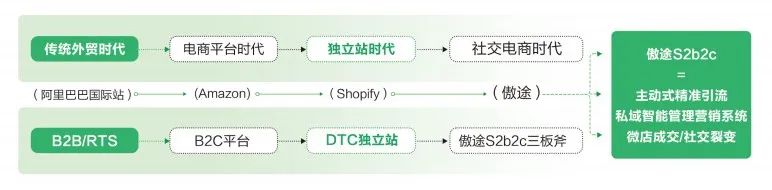
From the perspective of the evolution of the entire cross-border global expansion model, from the initial B2B cross-border sales to the later B2C cross-border e-commerce, to the hot DTC brand global expansion in recent years, an obvious problem is that everyone is short of traffic, lack of inquiries, and lack of customers. In addition, there is a clearly visible current situation that customers and traffic will not be fixed on one platform or channel forever. They will only transition from one platform to another, and from one form to another. In this process, what enterprises need to do is to seize the current dividend opportunity and assess the situation to cater for the development of opportunities.
For cross-border brands, they also need to seize the changes in the social media era, the era of decentralization, the era of fragmentation, and the era of consumer dominance, seize the opportunity of the S2b2c social e-commerce model, use social media and social networks, and use decentralized small B groups to create an ant army-style distribution growth system and build a strong channel brand to achieve cornering transcendence.
Domestic Yunji, overseas Meesho, DealShare, GlowRoad, cross-border Azambe and other brands have all achieved success using this decentralized social distribution model.
02
What exactly is the S2b2c business model?
In the book "Smart Business", Professor Zeng Ming analyzes the three traditional business models. They are:
- B2B: Business to Business, with Alibaba as the typical representative.
- B2C: Business to Customer, with Tmall, JD.com, and overseas Amazon as typical representatives.
- C2C: Customer to Customer, with eBay and Taobao as typical representatives.
Following the three traditional business models, in the future, the C2B model will be an important business model in the Internet era, a fundamental subversion of the traditional industrial era, and a business model that truly drives customers.The most typical feature of the C2B business model is that it is user-led, with users changing from passive recipients of goods to active participants and even decision-makers. The relationship between brands and users has gradually transformed from one-way value transmission to two-way value synergy. Customer drive is the starting point of the C2B model.
It can be said that the C2B model allows consumers to create all the products they want. However, due to current technological limitations, it is still difficult to establish a comprehensive and ideal C2B model, and it is difficult to replace the existing business model for a while. During this transitional period, a new transitional model—S2B—naturally emerged.
S2b2c belongs to the S2B model, which is of course a deformation of the C2B model and an upgrade of the traditional supply chain model.
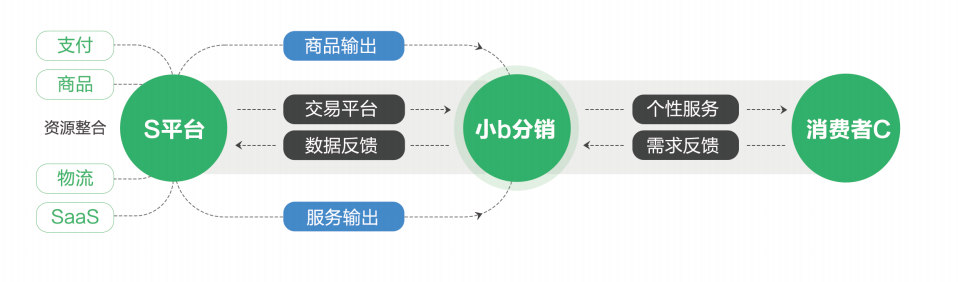
S refers to the supply chain platform Supply Chain, b refers to the KOC small b (business), and c refers to the customer.The epoch-making significance of S2b2c is that the S platform empowers countless small businesses and helps them complete services to customers c, that is, making full use of the social value of countless KOC small businesses (physical store owners, Internet celebrities, group owners, mothers, etc.) to create an ant army-style distribution system for enterprises and bring about exponential marketing growth.
Its core feature is that S and small B jointly serve c, which is much more valuable than a separate small B or a separate big B directly serving customers c. Their common services have two meanings:
First: When small B serves customer c, it needs to call on many enabling services provided by S, such as supply chain integration, payment and logistics integration, digital marketing SaaS empowerment, and intelligent data products, etc.; these enabling services can only be provided by S, because its investment and professional threshold are relatively high, which cannot be afforded by small B.
Second: The process of small b serving c is also a process in which S participates and obtains feedback in real time, which can improve S's empowering service to small b and improve the user experience of c's customers. In this process, the urgent need is to realize digital SaaS operations, online management, automatic collaboration, etc., so as to better serve c customers.
Different from the Internet platform model, the S empowerment platform may no longer be a traffic entrance, because it does not promise to provide traffic to small B and ensure the survival of small B. Each little B has his own circle of friends, and he can influence a group of people, and use his own circle to create an exclusive owned audience pool.
The core of the success of the S2b2c model is to find a large number of small businesses with their own owned audience to cooperate with, and then provide a complete platform empowerment for small businesses, giving full play to their independent capabilities to achieve successful transactions.
03
Why cross-border enterprises need S2b2c business model more
For cross-border enterprises, a significant change is that traffic is fragmented and incremental growth is difficult and expensive. Gone are the days of the original traffic-based approach, that is, tapping a batch of transactions from the public domain. At present, under the premise that incremental customer growth is weak, companies need to continuously tap customers from public platforms, and also build their own owned audience pools based on social media and social media that are the current user preferences, to achieve refined operations for customers, and to tap customers' lifetime value and social value, thereby achieving the goal of increasing ROI.
Specific to our cross-border industry, we actively embrace the S2b2c social e-commerce model based on social owned-channel marketing. There are several reasons for this:
From a traffic perspective:The cost of the original inquiry acquisition channels or forms is high, and customer acquisition is becoming more and more difficult. If you only rely on a single conversion, the ROI will not be positive or even negative, and the business operation will naturally be unsustainable. This is a typical transition pain from the incremental era to the stock era. For enterprises, at this time, they need to maximize the value of every single flow and realize the reuse of flow. Let each inquiry not only be successfully converted into an order, but also try our best to promote repurchase and referral, and convert it into more repurchase orders and recommended orders, that is, to realize what we often say is to maximize the lifetime value and social value of a single customer, thereby improving the business ROI.
From a user perspective:Almost all users will be immersed in social media and social platforms, and everyone is a creator and sharer. This will inspire many people to become influential KOC, and will further promote them to become distributors, creating conditions for enterprises to decentralize and fragment the sales model and realize the integration of parts. In the context of difficult growth in bulk trade, we will build an ant-like distribution growth system for enterprises.

From the perspective of the development strategy of cross-border enterprises:From cross-border e-commerce to brand global expansion, every cross-border enterprise hopes to leapfrog the dragon gate and become a global brand with industry influence. In the context of fierce competition, branding is difficult to achieve overnight. Based on the S2b2c social e-commerce model, brands can be empowered to strengthen users' minds and shape brand images in a decentralized and fragmented manner, thus empowering cross-border enterprises' DTC brand global expansion strategies.
S2b2c is the new trend dividend for cross-border enterprises to choose the global expansion model; if cross-border supply chains do well in S2b2c, they will not be afraid of the transfer of Chinese manufacturing overseas and shape the operating competitiveness of each brand.
04
What value can SocialEpochS2b2c provide?
It is naturally not easy to build a cross-border S2b2c social e-commerce model. SocialEpoch breaks this down into three key links and provides full product + service empowerment. This is also the entire content of SocialEpochS2b2c's three-part social owned-channel marketing overall solution. These three key links include:
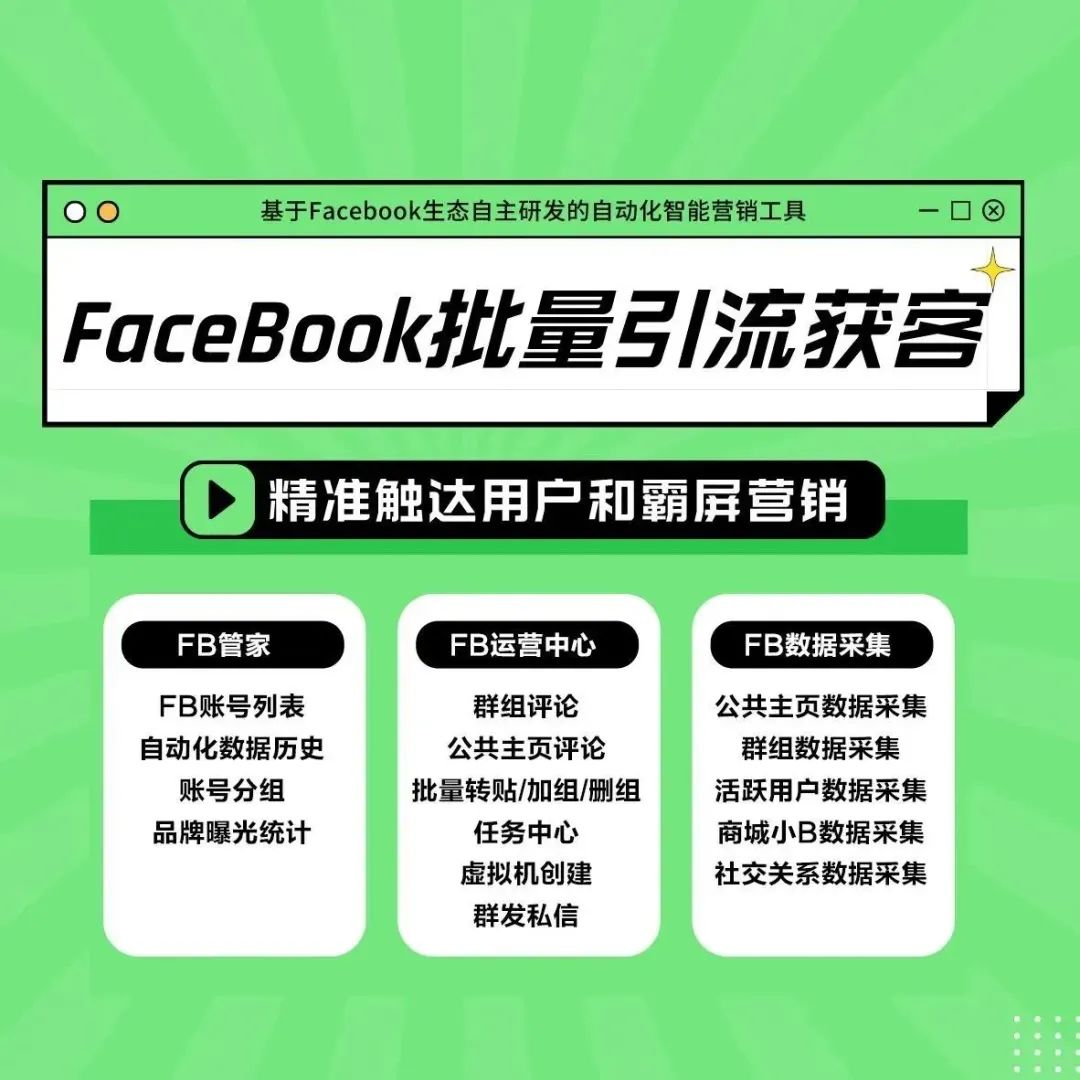
Social media batch acquisition: This part focuses on public domain social media traffic/inquiry. In any case, public domain traffic pool is the basis of every enterprise's owned channel and must be done. Nowadays, global traffic depends on social media, and global social media depends on Facebook. Based on leading social media like Facebook, every enterprise can use batch RPA tools to mine a large number of customer leads and achieve batch social media acquisition and social media sales.
Customer relationship progression: This link focuses on the operation of the company’s owned channels, thereby achieving the progression of customer relationships from fans to fans to customers to members to distributors. In other words, we must do a good job in refined customer operations based on Social CRM (SCRM), give full play to the lifetime value and social value of each customer, and lay a solid foundation for the next step of distribution growth.
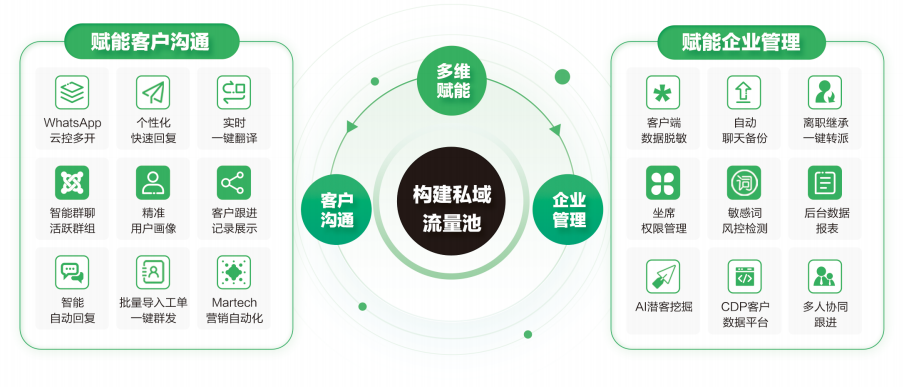
Social owned channels based on SCRM can bring these values to enterprises:
- Comply with each customer’s online social habits, making it possible to reach them directly online in real time;
- Save valuable customer data for each salesperson or salesperson to prevent data loss due to account suspension and other issues;
- Provide multi-account access, translation, vocabulary library, automatic reply and other functions to improve customer service quality;
- Empower internal collaboration and follow-up within the enterprise, establish a label system, and build a rich user portrait system;
- Provide marketing automation capabilities to achieve content marketing based on user portraits;
- Compared with traditional offline CRM, it can realize online socialization and digitalization of enterprise business operations.
distribution growth system: As mentioned before, the core of S2b2c’s success lies in giving full play to the independent capabilities of countless small businesses, thereby achieving distribution fission and successful growth. A distribution fission system is the digital foundation that supports Xiao B’s successful distribution. For example, SocialEpoch's KocShop fission micro-store/Azambe developed APP mall/TikTok Shop, etc., can all become small B distribution systems, empowering small B to complete digital construction, and enable distribution to be completed smoothly.
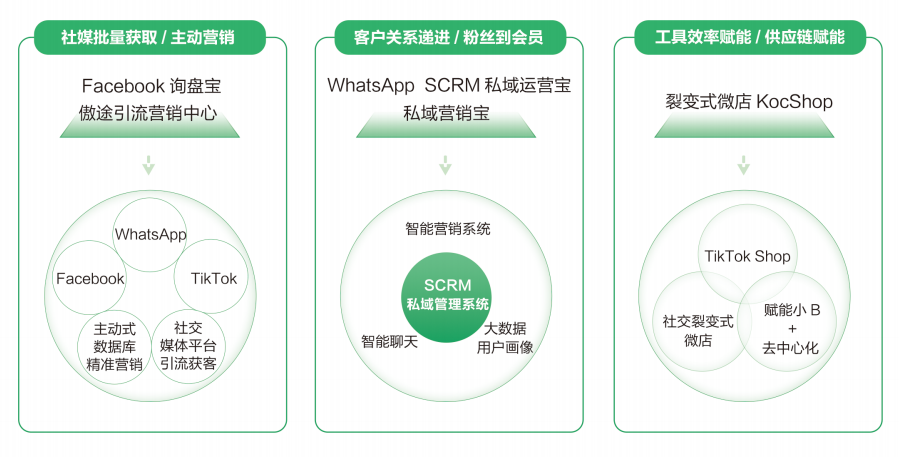
SocialEpochS2b2c is a new blue ocean model of global expansion in addition to B2B cross-border sales, B2C cross-border e-commerce, and DTC independent stations. It provides three major links of empowerment: active traffic + owned-channel operations + distribution fission. It uses the overseas social e-commerce model as a breakthrough point to empower every enterprise to build an Ant-hero-style distribution growth system.
05
Why choose the S2b2c three-axe model?
In the era of traffic fragmentation, user dispersion has become a reality. Traditional centralized marketing and sales methods can no longer meet the needs of global expansion companies. In this changing context, through the decentralized distribution model of countless small businesses, each global expansion company can solve marketing and sales problems and realize a distribution system in which the company sells itself, your distributors help you sell, and your customers help you sell. In the social era where everyone is a creator, we should give full play to each customer's independent capabilities, give full play to customer lifetime value and social value, improve corporate operating ROI, and empower companies to achieve strategic development from channel brands to global brands.