Case introduction: This case is a special case focusing on the cross-border S2b2c model. The interviewee is Azambe, a customer of SocialEpoch in Guangzhou. The case won the 2022 and 4th Unique Awards "Extraordinary Award" - the Best Overseas Owned-Channel Operations Award in the E-commerce Industry. Below, we also share this case, hoping to show you the full picture of the cross-border S2b2c model. The full text is about 13,000 words, and the specific content includes the following six parts:
- What is S2b2c model
- How Azambe accurately targets the African market
- How Azambe creates a cross-border S2b2c social e-commerce model
- How SocialEpoch empowers Azambe’s cross-border S2b2c model
- Azambe S2b2c successful customer cases
- Thoughts and prospects on cross-border S2b2c social e-commerce
Text:
Professor Zeng Ming, former Chief of General Staff of Alibaba, once mentioned, “The S2b2c model is the first breakthrough innovation model in the era of intelligent business” has gradually begun to show its potential in recent years. Domestic Yunji/Jiajia Traditional Chinese Medicine, overseas Meesho/DealShare/GlowRoad, cross-border Azambe and other brands have all used this decentralized social distribution model to achieve success.
So, after B2B/B2C/C2C, what is S2b2c social e-commerce? What is the differentiated value of this business model? Cross-border market crises and challenges continue. How can Azambe accurately target the African market and lock in the global expansion of the S2b2c social e-commerce model? In this process, how does the SocialEpochowned-channel operations solution enable Azambeglobal expansion? Finally, from the perspective of the entire cross-border industry and business model, what thoughts and explorations does SocialEpoch have on the value of the cross-border S2b2c social e-commerce model? We will make a summary at the end of the case. Next, please join us to explore the new world of cross-border S2b2c social e-commerce.
01
What is S2b2c model
In the book "Smart Business", Professor Zeng Ming analyzes the three traditional business models. They are:
- B2B: Business to Business, with Alibaba as the typical representative.
- B2C: Business to Customer, with Tmall, JD.com, and overseas Amazon as typical representatives.
- C2C: Customer to Customer, with eBay and Taobao as typical representatives.
Following the three traditional business models, in the future, the C2B model will be an important business model in the Internet era, a fundamental subversion of the traditional industrial era, and a business model that truly drives customers.The most typical feature of the C2B business model is that it is user-led, with users changing from passive recipients of goods to active participants and even decision-makers. The relationship between brands and users has gradually transformed from one-way value transmission to two-way value synergy. Customer drive is the starting point of the C2B model.
It can be said that the C2B model allows consumers to create all the products they want. However, due to current technological limitations, it is still difficult to establish a comprehensive and ideal C2B model, and it is difficult to replace the existing business model for a while. During this transitional period, a new transitional model—S2B—naturally emerged.
S2b2c belongs to the S2B model, which is of course a deformation of the C2B model and an upgrade of the traditional supply chain model.
S refers to the supply chain platform Supply Chain, b refers to the KOC small b (business), and c refers to the customer. The epoch-making significance of S2b2c is that the S platform empowers countless small businesses and helps them complete services to customers c, that is, making full use of the social value of countless KOC small businesses (physical store owners, Internet celebrities, group owners, mothers, etc.) to create an ant army-style distribution system for enterprises and bring about exponential marketing growth.
Its core feature is that S and small B jointly serve c, which is much more valuable than a separate small B or a separate big B directly serving customers c. Their common services have two meanings:
First: When small B serves customer c, it needs to call on many enabling services provided by S, such as supply chain integration, payment and logistics integration, digital marketing SaaS empowerment, and intelligent data products, etc.; these enabling services can only be provided by S, because its investment and professional threshold are relatively high, which cannot be afforded by small B.
Second: The process of small b serving c is also a process in which S participates and obtains feedback in real time, which can improve S's empowering service to small b and improve the user experience of c's customers. In this process, the urgent need is to realize digital SaaS operations, online management, automatic collaboration, etc., so as to better serve c customers.
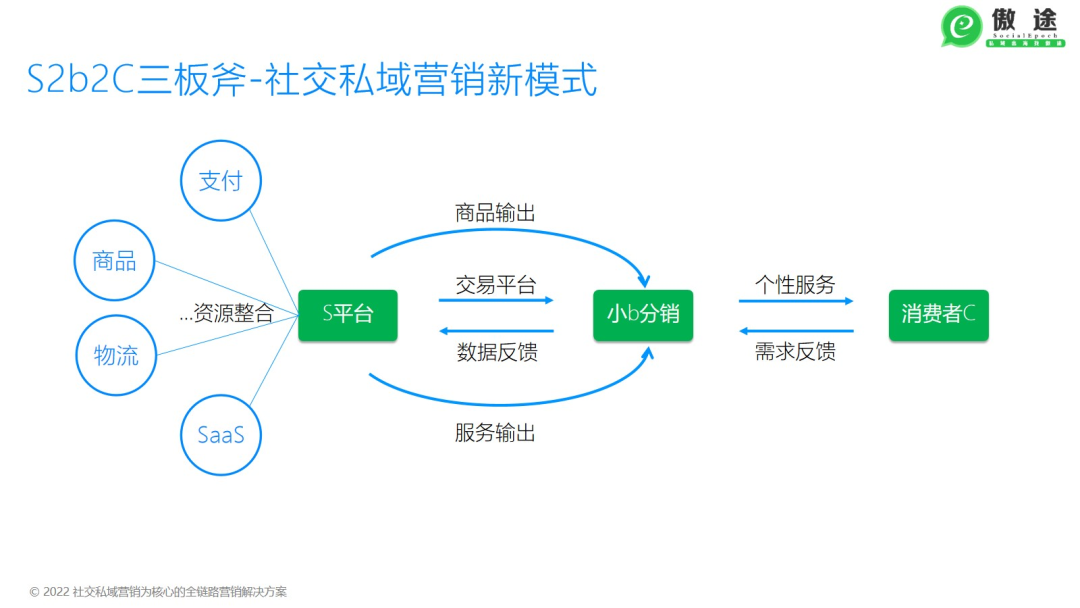
Different from the Internet platform model, the S empowerment platform may no longer be a traffic entrance, because it does not promise to provide traffic to small B and ensure the survival of small B. Each little B has his own circle of friends, and he can influence a group of people, and use his own circle to create an exclusive owned audience pool.
The core of the success of the S2b2c model is to find a large number of small businesses with their own owned audience to cooperate with, and then provide a complete platform empowerment for small businesses, giving full play to their independent capabilities to achieve successful transactions.
The empowerment provided by S to small B in the cross-border S2b2c model:
1. SaaS tools.
This is the most basic. S needs to connect and serve Xiaob through SaaS tools. For cross-border global expansion, it can build Xiaob’s exclusive owned audience pool based on WhatsApp (the world’s No. 1 social IM tool by monthly active users). At the same time, SaaS-based WhatsApp owned channel management system and KocShop fission micro-store system should be used to help Xiaob use WhatsApp to better manage and interact with c customers of the owned audience, so as to complete transactions conveniently and efficiently.
2. Centralized procurement in the supply chain.
Supply chain integration is an important part of the empowerment provided by S, which has great advantages over small B's own scattered procurement behavior. Prices are lower and product quality is more controllable.
3. Common quality assurance.
Using network digitization and online methods, Xiao B can provide consumers C with a unified user experience and quality delivery through the platform provided by S. Of course, S and Xiao B can also co-create and cooperate. They can have a dual-brand strategy, with S's brand and Xiao B's IP brand.

4. Network collaboration.
The S platform can collaborate with many upstream suppliers and integrate into a complete empowerment platform to assist small businesses, thereby serving consumers well. For example: integrating factories, brands, SaaS system services, warehousing, distribution, payment, customer service, training, content marketing and other links into one to jointly empower small B distributors. This greatly lowers the threshold for small B retail. Physical store owners, KOL Internet celebrities, community group owners, mothers and other small B groups can join and participate in distribution. Based on this, the small B group can exceed the scale of millions and millions, greatly driving S's order sales.
5. Data empowerment.
All interactive data and transaction data are centralized on the S platform. S can use its own resources, talents and financial advantages to conduct big data analysis, provide a detailed portrait of consumer C for small b distribution, and achieve more accurate distribution decisions.
6. Training and marketing empowerment.
The S platform should provide standardized training services to help Xiao B become familiar with the supply chain, familiar with the SaaS system and get started quickly, and familiar with the basic methods of community owned-channel marketing and order closing. At the same time, the S platform must continuously provide content marketing materials so that the small B homepage group can continuously output creativity, activate the community, and convert orders.
In short, the differentiated value of the S2b2c model is to find a large number of small Bs with their own traffic, and S empowers the small Bs to sell goods to C, creating a decentralized, ant army-style distribution growth system. For S, it leverages the huge advantages of its own supply chain empowerment system and solves the problem of traffic and growth; for small B, it leverages the value of traffic in the social circle and obtains distribution benefits; for consumer C, it solves the problem of trust in online shopping. Kill three birds with one stone and win-win for all three parties.
In recent years, affected by various factors such as the black swan incident of the epidemic, the peak of traffic caused by the disappearance of Internet dividends, the rising cost of public domain launches, and the tightening of regulatory policies on cross-border platforms, the B2B/B2C model marketing growth of the entire cross-border industry has been slightly weak. This has also given cross-border industry entrants a new opportunity to use the S2b2c differentiated model to enter.
Below, taking Azambe, a successful customer of SocialEpoch, as a typical case, we will focus on how the cross-border S2b2c social e-commerce model is implemented.
02
How Azambe accurately targets the African market
First: What are the opportunities for global expansion in Africa?
African economy grows against the trend: Africa is composed of more than 54 highly diverse countries and is divided into five regions: East Africa, Central Africa, North Africa, West Africa and Southern Africa. According to the "World Economic Outlook Report" released by the International Monetary Fund (IMF) in April 2022, Africa's total GDP in 2021 will be US$2,703.5 billion, a year-on-year increase of nearly US$300 billion. Africa's real GDP growth rate is 6.9%, exceeding the average levels of Europe, North America, South America, and the world. Against the background of the global economic downturn, Africa has become one of the regions with the largest economic recovery and strongest economic growth among all regions in the world. Foreign capital is also optimistic about the prospects of the African market and is rushing in to seize the layout and seek a larger market share.
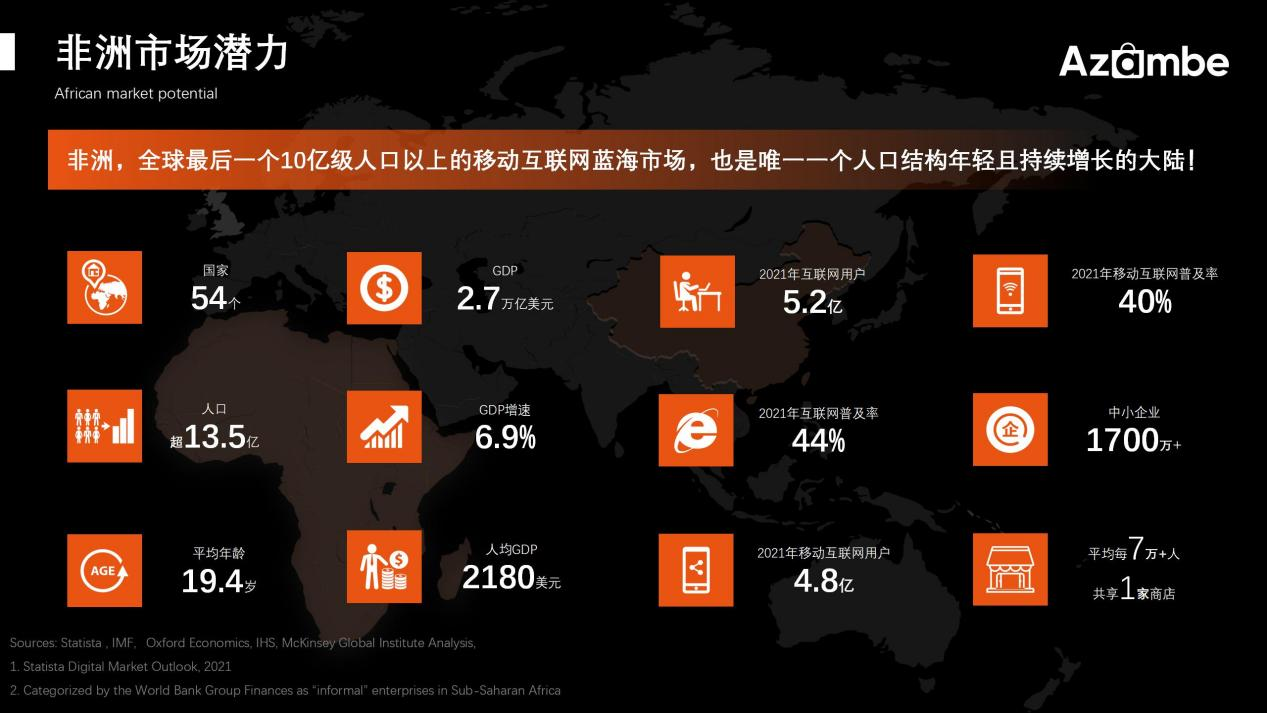
Africa’s demographic rejuvenation dividend: At present, Africa’s population is growing rapidly, the proportion of men and women is relatively balanced, and the population structure is getting younger. It has the largest and youngest user group in the world. Such a young demographic dividend will provide a unique user base for the development of the African economy, Internet, mobile Internet, e-commerce, social e-commerce, financial technology and vertical segmented service fields. With the awakening of African women's demands for freedom and equality, the pursuit of personal economic independence, and the explosion of beauty-loving nature, the "her economy" will usher in a strong explosion on the African continent in the future, and all businesses that help or revolve around African women will have great potential.
African market relies on Chinese manufacturing: Africa’s annual household consumption expenditure is about 4 trillion, and consumer demand for goods is strong. However, because Africa’s local industrial manufacturing base is very weak, it is completely unable to meet demand, and supply and demand are imbalanced. Therefore, all categories of African goods are highly dependent on imports, of which 90% of imported goods come from China. Local African residents favor China’s cost-effective manufacturing.
Opportunities brought by information asymmetry: Due to Africa’s backward transportation, communication and other infrastructure, the penetration rate of the Internet, mobile Internet and smartphones is still relatively low, and the supporting retail business formats are seriously insufficient (it is reported that there are few large-scale supermarkets in Africa, and an average of about 70,000 people share a convenience store). These objective basic conditions have led to opaque information obtained from the outside world by African countries and domestic regions, and information islands are prone to appear, leading to uneven regional development. The information gap can easily lead to large differences in the selling prices of local goods, a single category and different needs... Africa today is similar to China in the 1990s. Information asymmetry will bring huge opportunities to Chinese companies in global expansion in Africa, and use the opportunity of information asymmetry to export Chinese products, Chinese-style innovation and new business formats.

China’s cross-border sales shift to African emerging markets: Under the development pattern of "domestic and international dual circulation", China's cross-border sales exports to developed markets in Europe and the United States are growing weakly, and China's domestic trade market is becoming saturated and is in urgent need of change. It is an inevitable trend for China's cross-border sales to shift to emerging markets with strong growth such as Southeast Asia, the Middle East and Africa.
Policies and the overall environment of China-Africa relations: In recent years, under national strategic initiatives such as the “One Belt and One Road” and supply-side reform, the country has frequently introduced favorable policies to promote the development of cross-border sales, cross-border e-commerce and cross-border e-commerce logistics, vigorously create a good business environment for cross-border sales, and encourage companies to go global and develop in regions and countries related to the Belt and Road. As an important direction of the Belt and Road Initiative, Africa is an important direction, which creates good opportunities for global expansion in Africa.
Second: What is the potential of the African e-commerce market?
With the rapid economic development in Africa, the strong growth of the Internet and mobile Internet, the widespread popularity of smartphones, and the demographic dividend of one billion young people, e-commerce is developing at an alarming rate in Africa. The main manifestations are: the number of Internet and mobile Internet users and penetration rates in Africa are steadily increasing. At the same time, the penetration rate of e-commerce is far lower than that of other countries or regions. Taking China only as a reference, China's e-commerce penetration rate in 2021 is 81.6%, while that in Africa is only 27.9%. The African e-commerce market is blooming with immeasurable potential.
Of course, the development of e-commerce in Africa also faces many challenges: compared with e-commerce in mainstream regions around the world, Africa is very backward in infrastructure, logistics, payment, finance, data security, supervision and other aspects. These objective factors limit the vigorous development of e-commerce in Africa to some extent. Inadequate infrastructure, fragmented e-commerce market, low trust in online shopping, payment, logistics and delivery issues are all factors limiting the rapid development of e-commerce in Africa.
Although the development of e-commerce in Africa faces many challenges. The current number of e-commerce users is limited and the market size is relatively low. However, as African governments increase their efforts in infrastructure construction and e-commerce support, foreign capital pours in, Internet and mobile Internet coverage increases, infrastructure continues to improve, and innovative technologies such as financial technology mobile payment emerge, African e-commerce players are constantly pouring in. Relying on Africa's huge demographic dividend and strong potential market demand, e-commerce is bound to usher in a blowout explosion on the African continent.

Third: What are the prospects of social e-commerce in Africa?
With the popularity of social media, live broadcasts and short videos, Millennials (the generation born from 1980 to 1999) and Generation Z (the generation born from 1995 to 2009) are keen on social communication and sharing, pursuing shopping experiences in decentralized scenarios and emerging consumption methods. As an emerging e-commerce model, social e-commerce has become popular among young users around the world and is entering a stage of rapid development.
According to the social e-commerce research report "Why Shopping Will Trigger a Social Revolution" released by Accenture, by 2025, the growth rate of the global social e-commerce industry will be three times that of the traditional e-commerce industry, and global social e-commerce sales will increase from From US$492 billion in 2021 to US$1.2 trillion in 2025, social commerce is expected to account for 17% of all e-commerce transactions. Millennials and Generation Z users are the main driving force for the development of social commerce, and they will contribute 62% of global social commerce spending.
According to the "Middle East and Africa Social Commerce Market First Quarter 2022 Report" released by Research And Markets.com, social commerce in the Middle East and Africa is developing strongly. The social commerce market size is expected to reach US$8.9037 billion in 2022, with an annual growth rate of 38.9%. The compound annual growth rate from 2022 to 2028 will be as high as 35%. By 2028, the social commerce GMV of the Middle East and Africa will reach US$40.6951 billion.
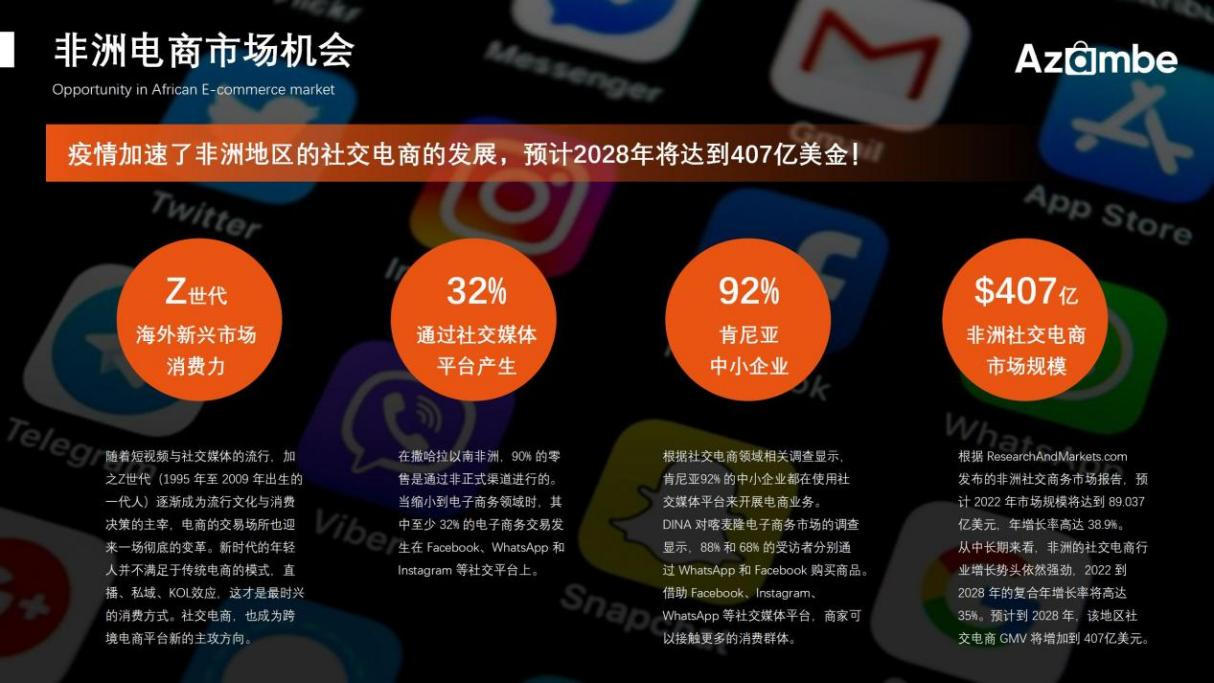
In addition, Africa has a huge base of young social media users, and the average daily use time of social media far exceeds the global average. These have laid a solid foundation for the rise and development of social e-commerce. At present, the social e-commerce landscape in Africa has not yet been formed, and there are few players in the social e-commerce track.In the face of such a historic opportunity, Azambe has the insight and courage to be the first in the world to differentiate and globally expand Africa with the S2b2c social e-commerce model.
03
How does Azambe create a cross-border S2b2c social e-commerce model?
Previously, the entire business model was transforming from the B2B/B2C/C2C era to the S2b2c era. Later, social e-commerce opportunities and challenges coexisted in the African market. Azambe is stepping forward at the turning point of differentiation.In August 2021, Guangzhou Xinghan Simba Technology Co., Ltd. officially established Azambe, a social e-commerce platform for the African market, to build an innovative cross-border S2b2c social e-commerce business model for Africa.
At the beginning of its establishment, Azambe was positioned as not just a simple social platform for selling goods, but an operating system that integrates suppliers, social distributors, and end consumers. It is committed to better empowering more African social distributors (small B), driving more African users to embark on the road of easy entrepreneurship and making money, and realizing a social e-commerce platform with freedom, equality, and economic independence.
In the top-level design of the S2b2c business model, Azambe, as the super platform "S", builds a one-stop supply chain system, making full use of the core advantages of China's supply chain and Made in China, integrating upstream high-quality supplier/brand owner/manufacturer resources, and creating a one-stop comprehensive service that integrates strict selection of supply sources, big data product selection, logistics fulfillment, payment, store management, marketing promotion and after-sales to empower small businesses, helping them to open a store for free and easily. Xiaob can set its own price, share the store link to social platforms such as Facebook/WhatsApp/Instagram with one click, easily sell goods to c-end consumers, and receive distribution commissions after successful sales, realizing the beautiful idea of "making money easily anytime, anywhere, anywhere".
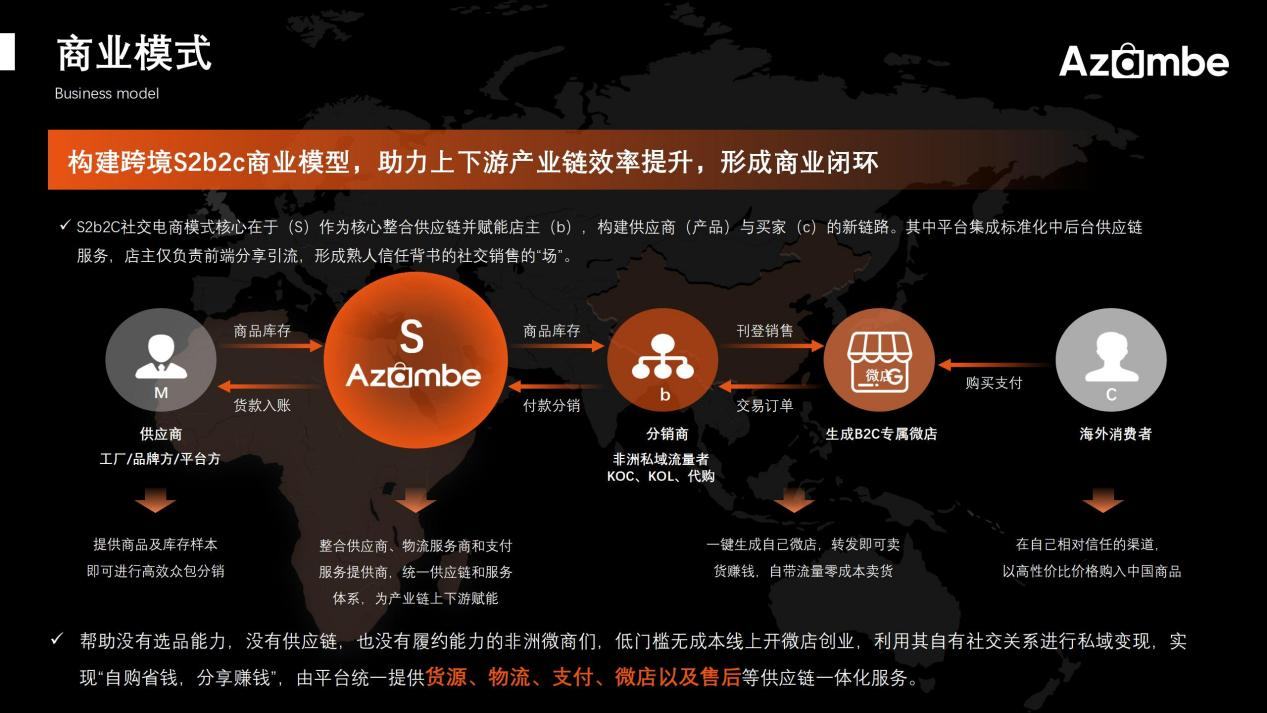
In the entire Azambe S2b2c social e-commerce model, Azambe has created an operating system with its own supply chain platform (Supply Chain) as the core.
up: Integrating high-quality resources from many factories, brands, and platforms, emphasizing product source manufacturer prices, using big data selection to provide the African market with a large number of cost-effective personalized products that meet local consumer needs, with exclusive inspection and quality assurance.
down: Empower countless distributors (such as African agents, purchasing agents, overseas students, mothers, shop owners, Internet celebrities, group owners, etc.) through the supply chain and SaaS system, and combine it with the self-developed micro store - Azambe APP to create an exclusive distribution micro store for each small business. In this micro-store system, every little B only needs to forward and share, and after the transaction is completed, they can get commissions and shares, and make full use of the value of their own social circle to gain income.
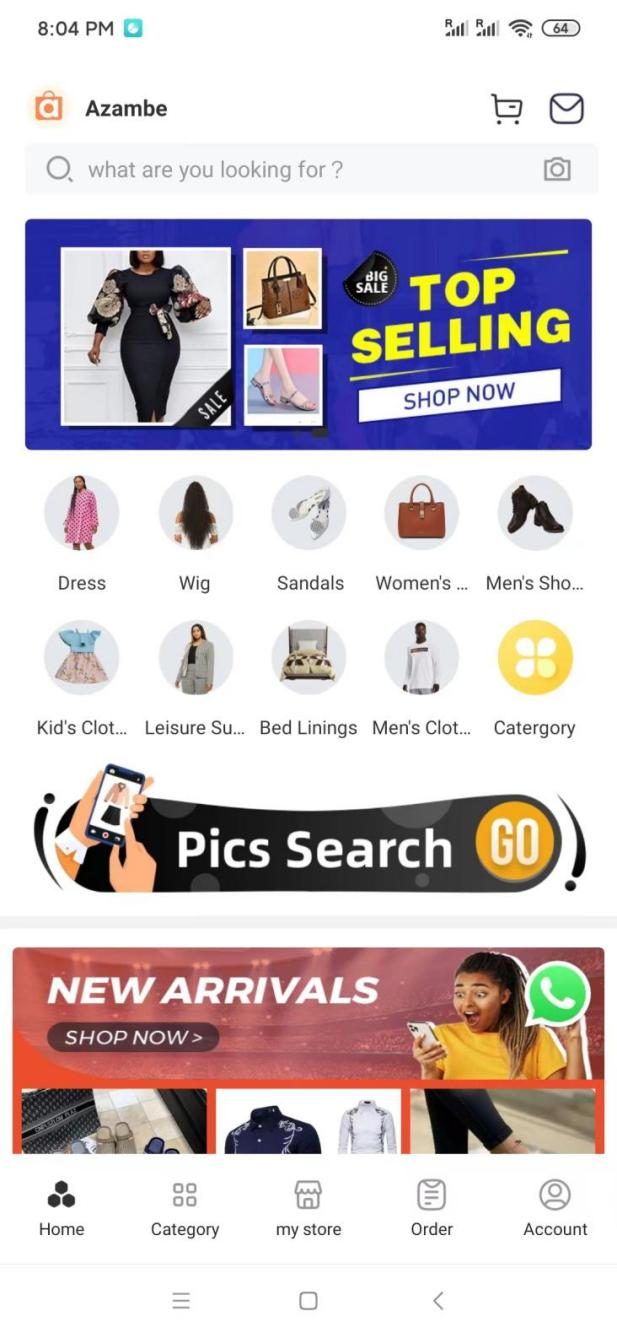
On the other hand, for consumers C, they can buy ideal products from trusted friends in their social circle, eliminating the trust crisis of online shopping and getting more with one stone.
In addition, Azambe uses its own supply chain platform and APP as the core to achieve complete empowerment and services such as offline supply, logistics delivery, online payment, independent pricing, social sharing, customer management, mobile wallet, and social distribution, creating a mobile social e-commerce platform where everyone can participate in China-Africa trade. As a result, it helps Xiao B sell goods easily and achieves a win-win situation for upstream suppliers, Azambe, Xiao B and C customers.
04
How does SocialEpoch empower Azambe’s cross-border S2b2c model?
In Azambe’s entire business model, there are two marketing growth points worthy of attention:
The first is how to find a large number of small businesses quickly and at low cost, and invite them to become distributors of the S platform;
The second is how to tap the LTV lifetime value and social value of Xiao B. In short, it is how to make Xiao B sell more and longer, and even recommend more Xiao B to participate in distribution and sales.
These two points are also SocialEpoch's two major empowerment directions for cross-border marketing growth: traffic and retention.Below, we analyze them one by one.
First: How does SocialEpoch empower Azambe to find traffic?
When the traffic dividend disappears, when public domain customer acquisition becomes more and more expensive, when it becomes more and more difficult to attract traffic, traffic becomes a common growth problem for all enterprises. In this regard, SocialEpoch firmly believes thatPublic domain platformIt is always the basis of customer acquisition for enterprise merchants. Without a source of running water, it is difficult for an enterprise to break through from 0 to 1 and obtain the first wave of recognition and growth.
Here is a brief explanation of publicly owned channels: owned channels are directly owned by brands or merchants and can be reached repeatedly at low cost or even free of charge. The owned audience pool is a breeding ground for interactions and relationships between brands and users. Corresponding to this is the public traffic pool, that is, the user assets do not belong to the brand's own field——Public domain traffic。
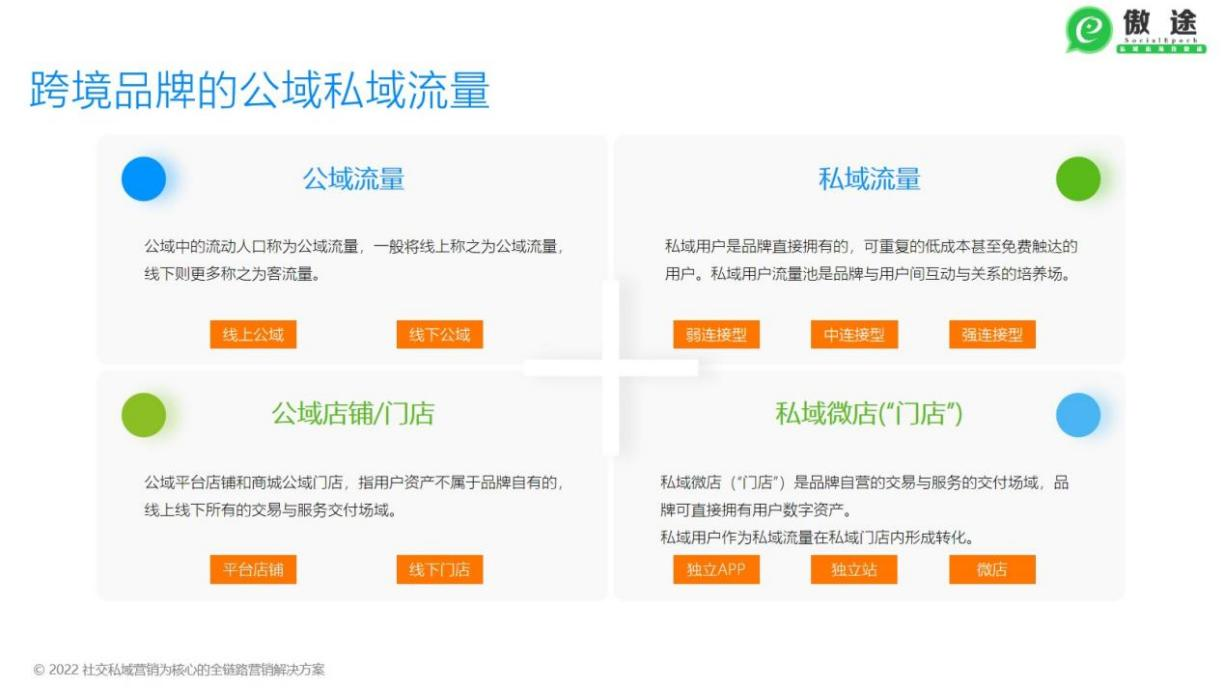
Where is the overseas public domain traffic? Online are platforms such as Amazon, Google, and Facebook, and offline are stores and mall stores. In the social era where users are socializing online and becoming digital, social media represented by Facebook has become a gathering place for users’ time and attention.
According to Statista data in early 2022, Facebook's global monthly active users (MAU) have reached 2.91 billion, making it the king of global social media. Facebook is also recognized as the preferred public domain platform in overseas markets. Currently, there are basically two customer acquisition methods for Facebook, a treasure trove of traffic:The first is advertising, the second is social media operation.
It can be concluded from the above that as the global Internet traffic dividend has peaked and advertising has become increasingly difficult, Facebook social media operations have become a breakthrough point for overseas customer acquisition. For overseas public domain, look at social media, for social media customer development, look at Facebook, and for Facebook traffic, look at operations. Based on this premise, SocialEpoch created an operation + traffic tool based on the Facebook ecosystem - Facebook Inquiry Bao (Drainage Bao), which revolutionizes the customer acquisition efficiency of Facebook operations through batch account matrices and automatic operation of RPA scripts.
SocialEpoch found that many companies’ Facebook traffic was not effective. The root cause is not that the company’s products or promotional content are not good enough, but that the amount of display on the entire Facebook platform is insufficient.
SocialEpoch Facebook Inquiry Bao (Drainage Bao) has two core functions of batch collection and RPA script automated operation, which can help enterprises quickly find potential customers in massive Page/Group/Post/MarketPlace and improve customer acquisition efficiency; it can also be combined with RPA script operation to implement a matrix operation system that manages thousands of accounts on one device, exponentially increasing the amount of publicity and display, improving account operation efficiency, and reducing personnel costs.
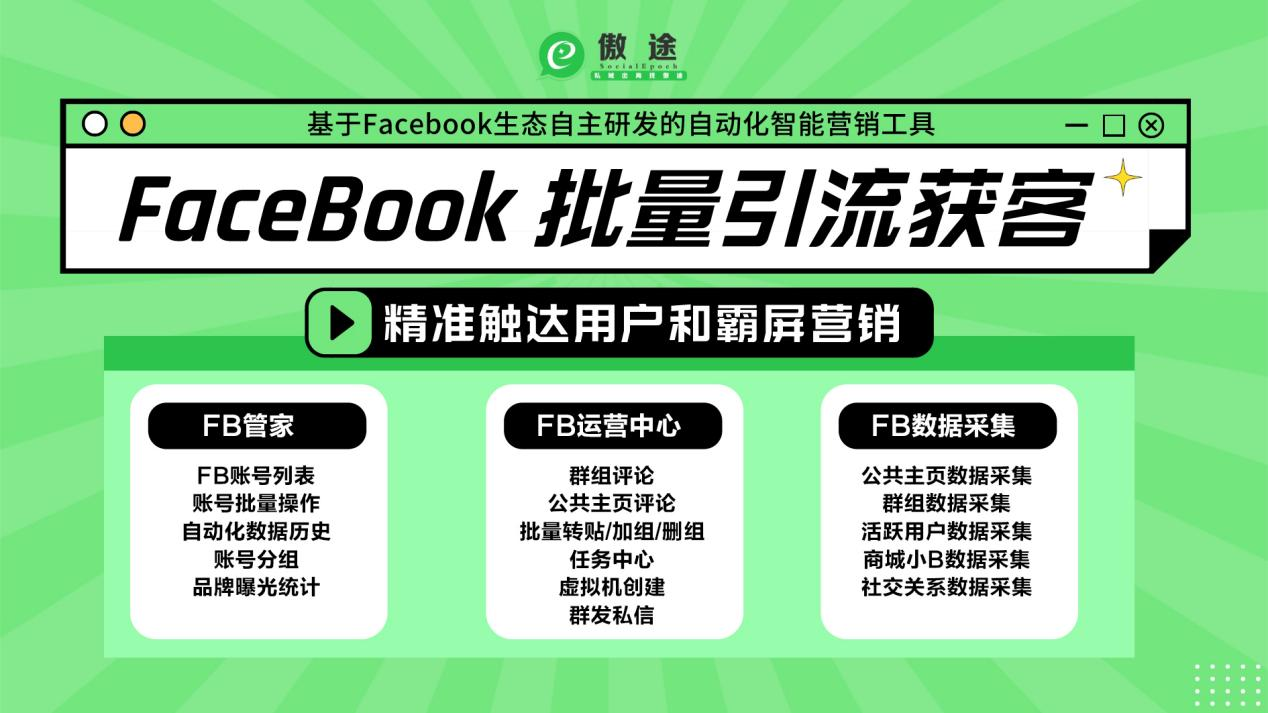
Unlike many B2B cross-border sales and B2C cross-border e-commerce, Azambe's customer group is relatively special, belonging to small B or big C with their own social traffic and willingness to distribute. They may be mothers, shop owners, KOC Internet celebrities, group owners, international students, agents, etc. Here, the great value of Facebook Drainage is that it can find a large number of users related to Group/Page/Post/MarketPlace scenarios through keywords, reach and market these precise target groups through batch account matrix and RPA script operation, and develop them into distribution agents.
The following takes a Group group as an example to briefly describe a traffic diversion method of Facebook Query Bao (Diversion Bao):
Step 1: Log in to the Facebook Query Bao (Diversion Bao) system. Up to 10 accounts can be logged in in batches at one time through the virtual machine, improving operational efficiency and reducing operating costs.
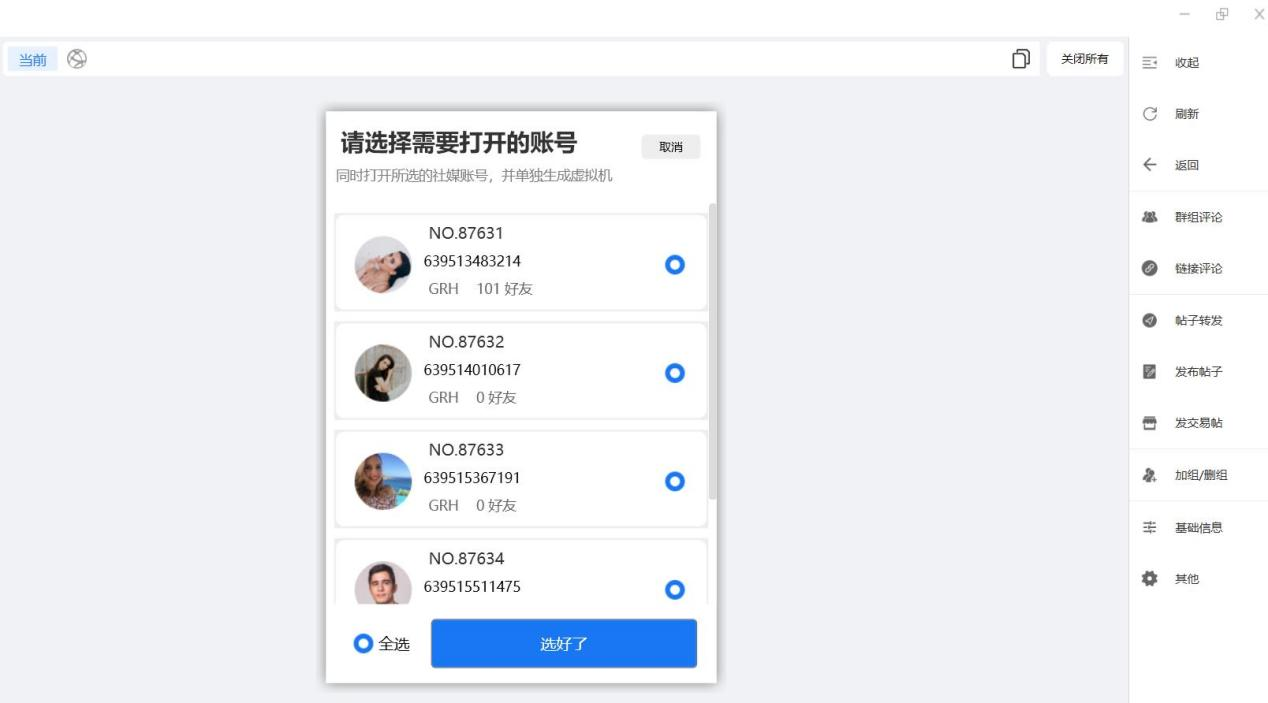
Step 2: In the batch adding function, industry-related groups can be obtained by combining keywords such as target groups and countries and regions. Within the group adding function, companies can continuously filter and add groups based on parameters such as keywords, region, quantity, and whether it is public.
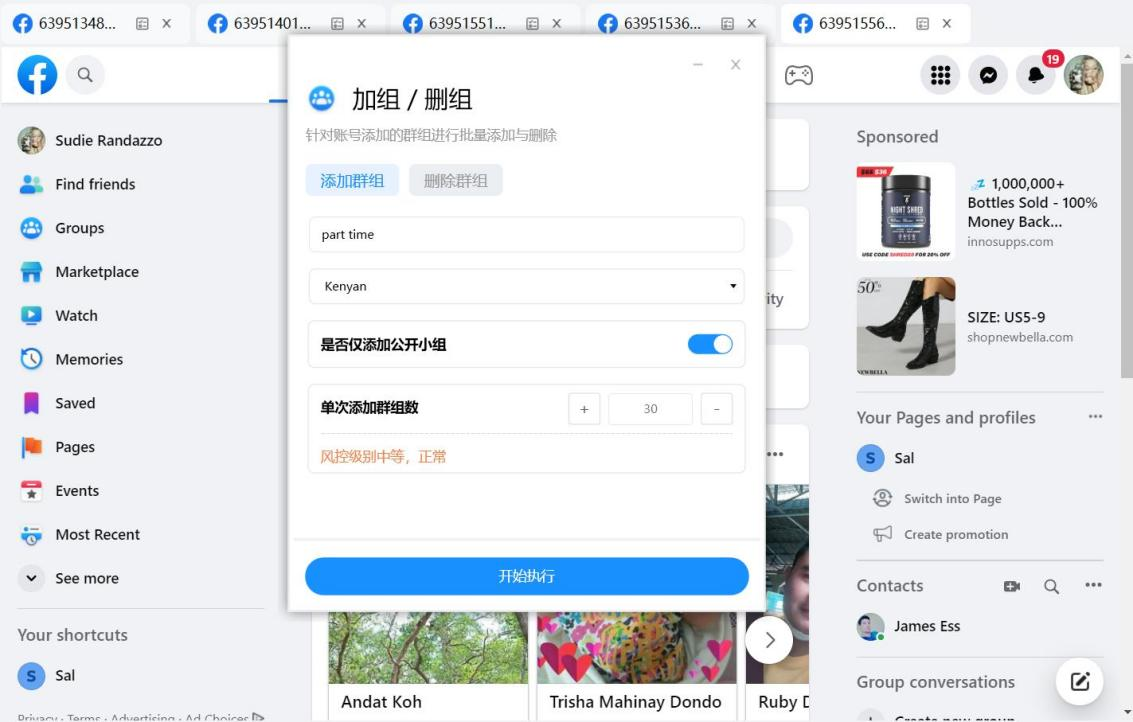
Step 3: Combined with the automatic script running function of group comment RPA, it can repeatedly reach group members, guide small B customers to convert and build relationships, and convert group members into corporate owned audiences.
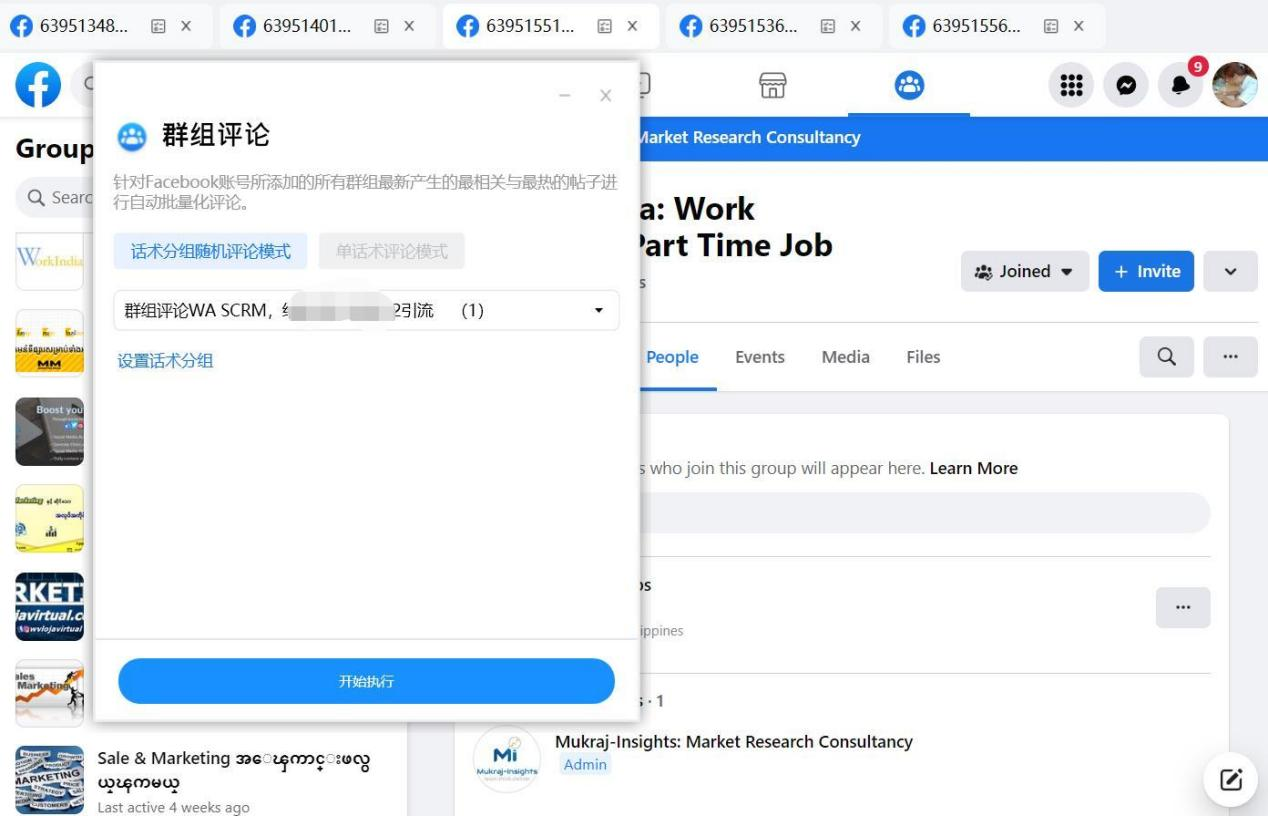
Step 4: One computer can create 100 virtual machines, and one virtual machine can log in to 10 accounts. This means that one device can manage up to thousands of Facebook accounts for repeated operations. As a result, enterprises can repeatedly add groups → group comments → guide and establish alliances, etc. to find a large number of small B groups with distribution intentions and capabilities in a large number of relevant groups, and accumulate their own distribution small owned audience pool.
Summary of Azambe's incremental traffic drainage method: do a good job of sales intelligence and proactive outreach based on social media matrix operations.
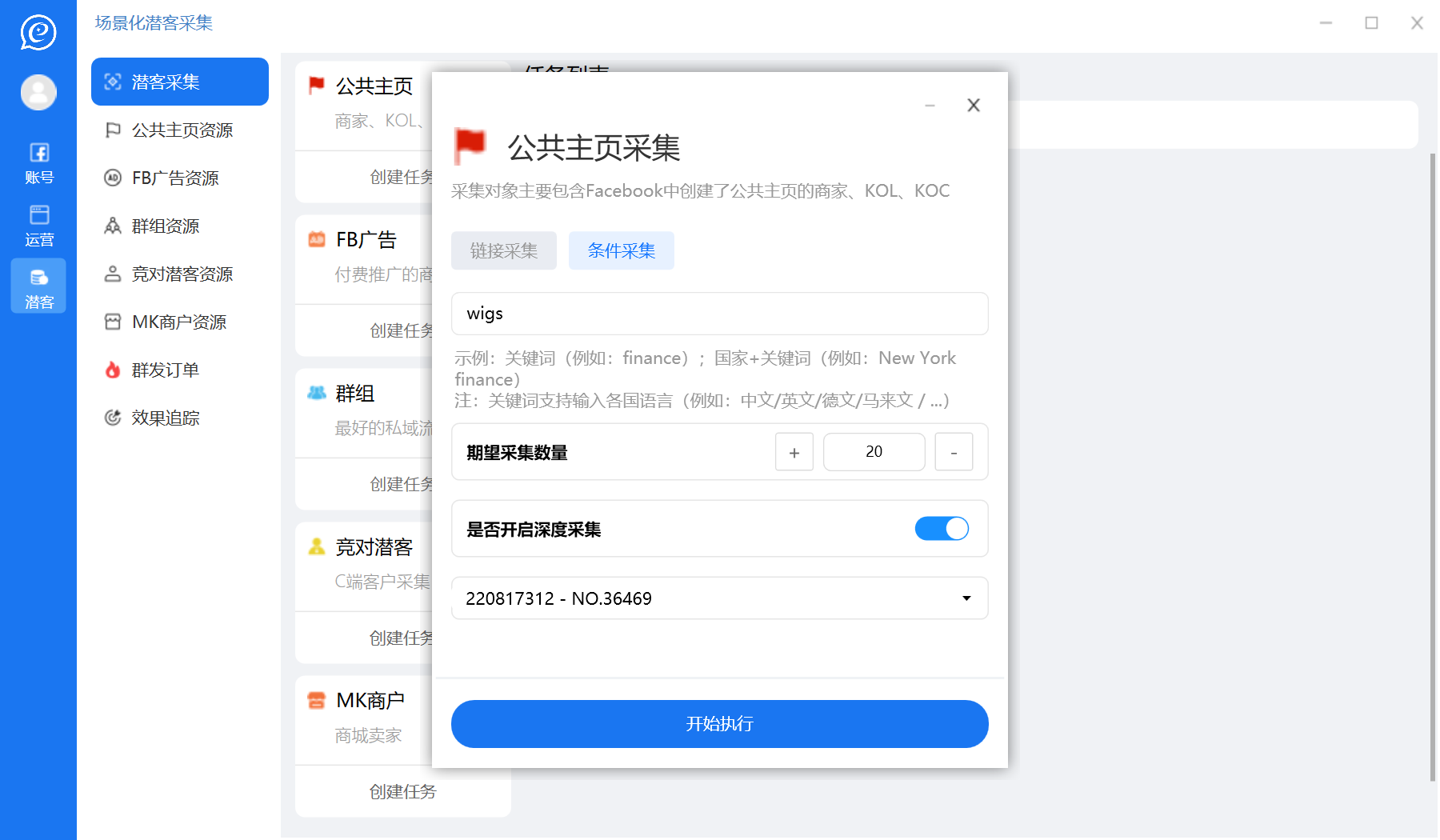
Take Facebook as an example. There will definitely be a large number of customers in all channels such as Group/Post/MarketPlace/Page of this social media giant platform. Each company can combine keywords and regions to explore potential customers in these channels, capture massive potential customers through information systems, and solve problems.sales intelligenceproblem.
The picture below shows the process of Azambe operators combining customer keywords to obtain sales intelligence. At this stage, using account matrix + RPA script + automation can greatly improve the efficiency of obtaining sales intelligence.
Of course, sales intelligence alone is not enough. After finding customers, proactive contact and social networking are more important. All potential customer leads obtained from sales intelligence can be reached through the batch account matrix or official channels. For example, RPA systems such as WhatsApp official API (WABA) bulk messaging, Facebook Query Bao (Drainage Bao) account matrix, or other proactive and precise contact methods.
At this stage, every company should talk about where the information is. Compared with traditional emails and text messages, social media contact is more efficient and direct, more in line with online social and digital user habits, and reduces losses caused by too long circulation paths of business opportunities.
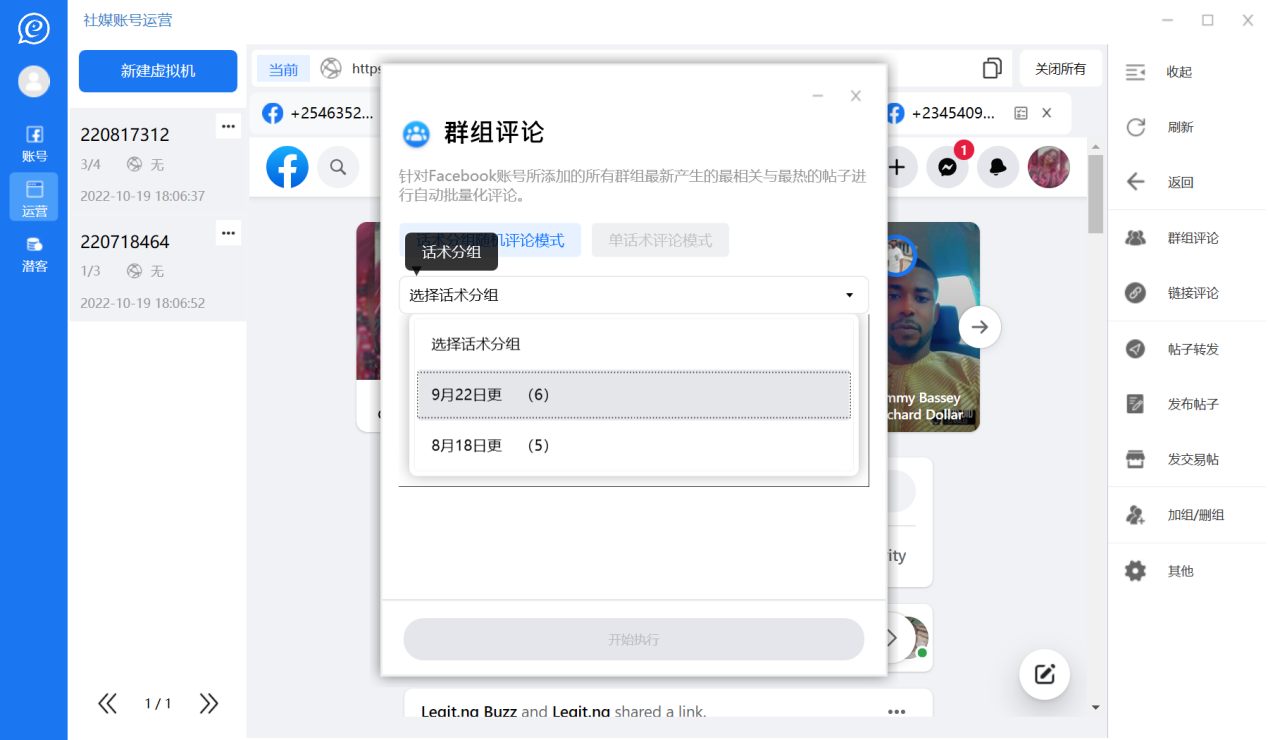
As shown in the picture below, Azambe operators prepared different script classification techniques for the potential customer groups discovered, and carried out corresponding content marketing based on the characteristics of the group users. They used matrix accounts to continuously actively reach and communicate with users and establish connections with customers.
Based on social media matrix operations, we will do a good job of sales intelligence and proactive outreach to lay a solid foundation for incremental acquisitions.SocialEpoch Facebook Inquiry Bao (Drainage Bao) is a batch collection and account matrix RPA operation tool for Facebook's four major marketing positions. It helps Azambe solve the public domain customer acquisition problem within Facebook - the traffic problem.
It is worth noting that Azambe’s incremental acquisition is not limited to Facebook social media itself. Azambe also has a self-built APP. By exporting customer contact information in the background and using the WhatsApp SCRMowned-channel operations treasure work order import function, it can realize the social connection of APP customers and precipitate a strong connected owned audience pool outside the APP.

Second: How does SocialEpoch empower Azambe to retain volume?
At one time, everyone only focused on how to attract traffic. Now, do we need to pay more attention to how to operate and maximize the value of the traffic that has already come in? We all know that domestic owned-channel operations have been professionally standardized for three years. Owned-channel operations based on WeChat have made countless merchants full of money; of course, the emphasis on owned channels does not mean that the value of public domain is no longer there. There is no owned channel without public domain. Only with the source of public domain can the flourishing of owned channels be achieved.
Online, social, and digital are the common characteristics of this generation. In the past three years of the professionalization of domestic owned-channel operations, social owned channels using WeChat as a carrier have revolutionized the quality, efficiency and sales of many companies. Reducing customer acquisition costs, achieving one-on-one contact with users, and accumulating corporate digital assets have become obvious values of the owned channel model.
In recent years, whenever marketing growth is mentioned, the term owned channel will be a steady guest. With the rise of the domestic owned channel 3.0 era and the overseas owned channel boom, current owned-channel operations have already extended from what they were and whether they were done to a new stage of how they are done now.
SocialEpoch's overseas owned-channel operations solution is localized and sublimated based on the successful experience of domestic WeChatowned channels. It originally developed a SCRM (Social CRM) product based on the WhatsApp ecosystem and empowered the refined operations of Azambe's small owned channel in two major directions:
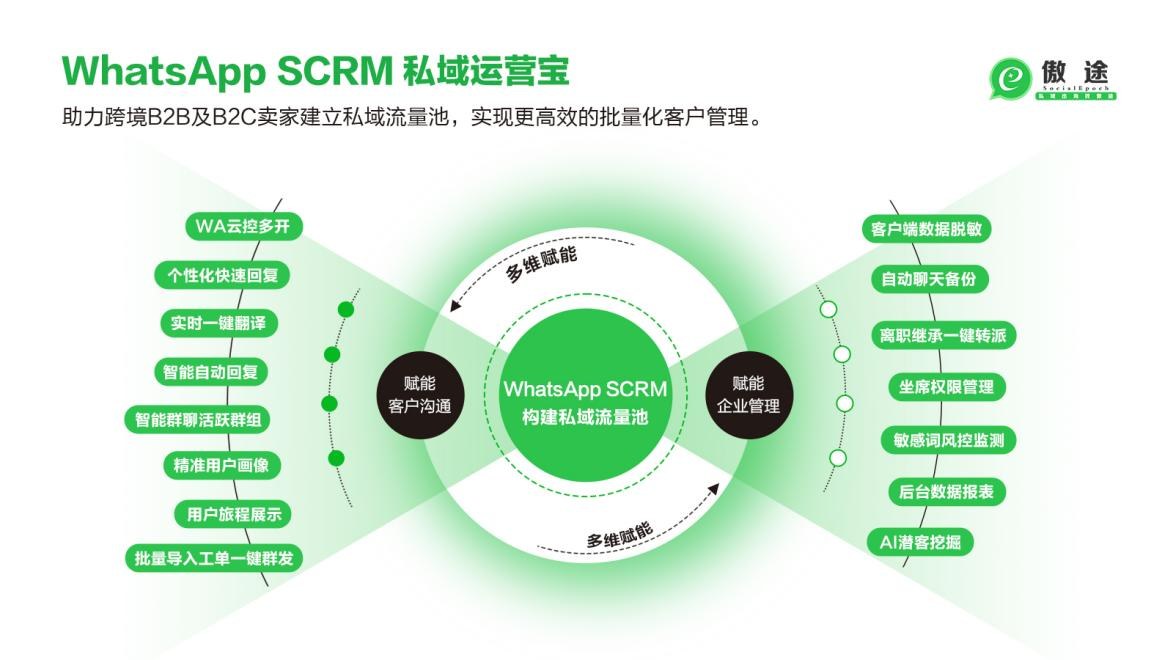
One: Empower external communication with small B customers.
For Azambe, small B customers also have the characteristics of long links and long-cycle conversions, and the entire transaction process will produce countless communication interactions. Combined with some shortcut phrase libraries, chat robots, one-click translation, smart group chat, user portraits and other functions, front-line salespeople can be quickly empowered in a short time and improve the efficiency and quality of communication and follow-up.
Taking the reply phrase library and chat robot settings as an example, customer experience is a very important influencing factor in the refined communication process with Azambe Xiaob customers, which largely depends on the timeliness, accuracy and professionalism of the reply. Reply to customers efficiently in the first time, fully understand customer needs while providing "symptomatic" answers, and provide professional answers for special categories and specific cultural environments... These are all urgent needs.
There are so many frequently asked questions and Q&As, why not create a vocabulary library?
Many customers will have many repeated questions during communication and follow-up. Faced with these questions, the answers from different salespeople may be like the Eight Immortals crossing the sea, each showing their magical powers, or they may be a mixed bag of good and bad. In order to fundamentally solve this problem, Azambe organized common problems and organized them into a professional vocabulary library to empower salespeople to fight on the front line.
More than that, it is not enough to sort out the contents of the chat library. It must also be convenient for all partners to use immediately. Here, combined with the quick reply settings of WhatsApp SCRM, convenience and efficiency are truly achieved.
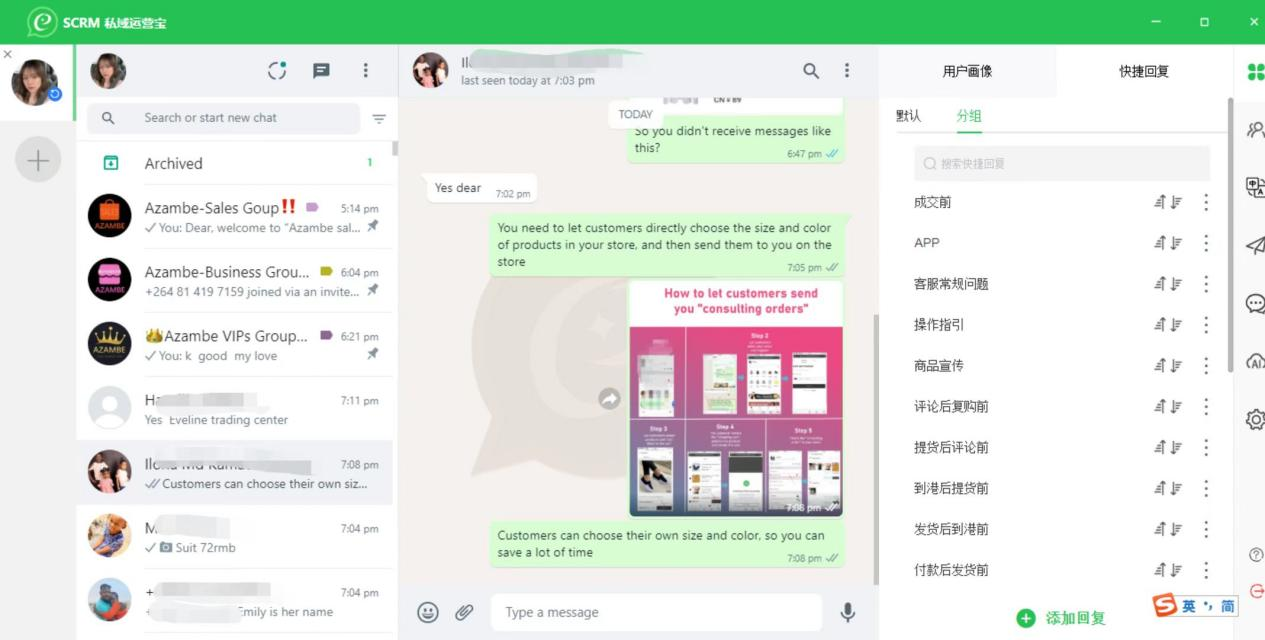
The management background, PC client, and WaChat mobile terminal all support adding and modifying quick reply content. On the client side, each salesperson can add words, edit the content of words, adjust the order, group, etc. in the quick reply column. They can also take them out and copy them on the right side of the conversation bar, which greatly improves the efficiency and quality of replies. Customers can also feel the efficiency and professionalism of the company.
Once the chatbot is set up, no customer can escape!
A chatbot that can automatically reply and answer questions based on customer needs or key content is also important. In the SocialEpochWhatsApp SCRMowned-channel operations product, combined with the setting of keyword replies, Azambe creates its own exclusive intelligent chat robot.
In each reply setting, you can set up to ten keywords and five replies. The response time and response method can also be flexibly changed. N words like this, coupled with personalized settings, can even give customers the communication effect of "confusing fakes with real ones, replacing real people with robots". In actual business communication, it can help companies fully liberate salespeople from tedious and elementary communication, reduce work and improve communication efficiency.
During the actual operation, Azambe can help sales staff achieve efficient front-end communication with customers and improve work efficiency by using functions such as the vocabulary library, automatic replies, account cloud control multi-account access, and smart group chat in WhatsApp SCRM.
Second: Internally empower salespeople to collaborate internally.
Internally, before and after the conversion of small B customers, internal docking and communication will be a time-consuming and labor-intensive project, and there may even be errors and omissions. To achieve perfect internal docking and communication, an online internal collaboration tool is indispensable, and this is another value of the SocialEpochSCRM product - internal collaboration and customer portraits.
Before the SCRM era, customer follow-up records were relatively lagging and scattered. Many salespeople contact customers through various forms such as emails, phone calls, IM tools, etc., and then complete follow-up records within the CRM. First, customer data is relatively lagging behind, and second, there is an information gap.
In the era of WhatsApp SCRM, these problems no longer exist. Adding customers to IM tools such as WhatsApp can easily realize online socialization and digitalization of business operations.
First, IM determines the premise for online instant communication;
Secondly, SCRM is based on original ecological research and development design, and realizes online and real-time customer data follow-up records under the premise of online instant communication.
By opening WhatsApp SCRM, every Azambe salesperson can communicate with small customers while writing follow-up notes. They can also write follow-up notes without leaving WhatsApp. These follow-up records include but are not limited to user basic information such as name, gender, occupation, email, address, notes, tag information, customer stage, customer source and other dynamic information. You can also freely edit customer follow-up records and add pictures. Chat communication on the left and follow-up records on the right are timely, efficient and true, improving the salesperson's follow-up efficiency.
Writing needs to be efficient, and viewing needs to be even more efficient. Within WhatsApp SCRM, click on the conversation box to directly view the follow-up information of each customer. With a clear understanding of the customer's situation, you can naturally respond to customer needs calmly. This is what is called personalized precision marketing for thousands of people.
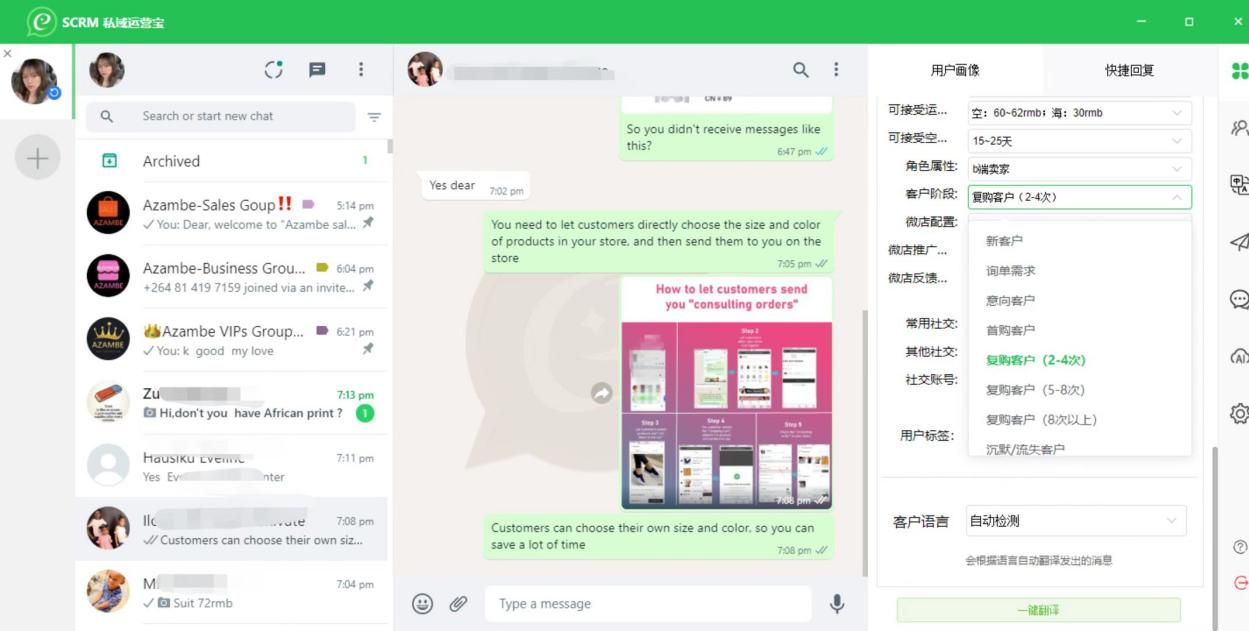
As mentioned earlier, Azambe's small B customers are characterized by long links and long cycles. Unlike C-end users who can complete transactions instantly, small B merchants will also undergo repeated communication and consideration before they can successfully transform into Azambe's distributors. Faced with these super users, in-depth 1V1 refined operational communication determines the customer experience, and also determines whether the customer completes the transaction, repurchases or even makes a referral. In the SCRM system, customer data and labels are presented intuitively and directly on the right side of the conversation bar, which can effectively empower front-line service communication. Use information tools to reduce the workload of front-line salesmen, improve efficiency and customer experience, and reduce internal consumption of inquiries.
Azambe's operations staff do this very carefully: when dealing with new and old customers, they classify and label them from the customer stage. When distributing content, they distribute different types of content based on the customer stage. Old customers share promotional content, and new customers are invited into the group for batch marketing to promote conversion; they treat customers with different preferences, such as the original Clothing customers who are small sellers can share specific clothing category content and match customers with corresponding needs, groups and preferential information. For customers who have used Weidian, they can also be grouped and tagged to share with customers the material content of Weidian Xiaob's profits, etc., to achieve content push and reach thousands of people based on the SCRM system.
The one-to-one information barrier has been broken down. What if it is a many-to-one situation? Because it involves communication and follow-up between different departments and personnel before, during and after the transaction. Of course there is a solution: collaboration!
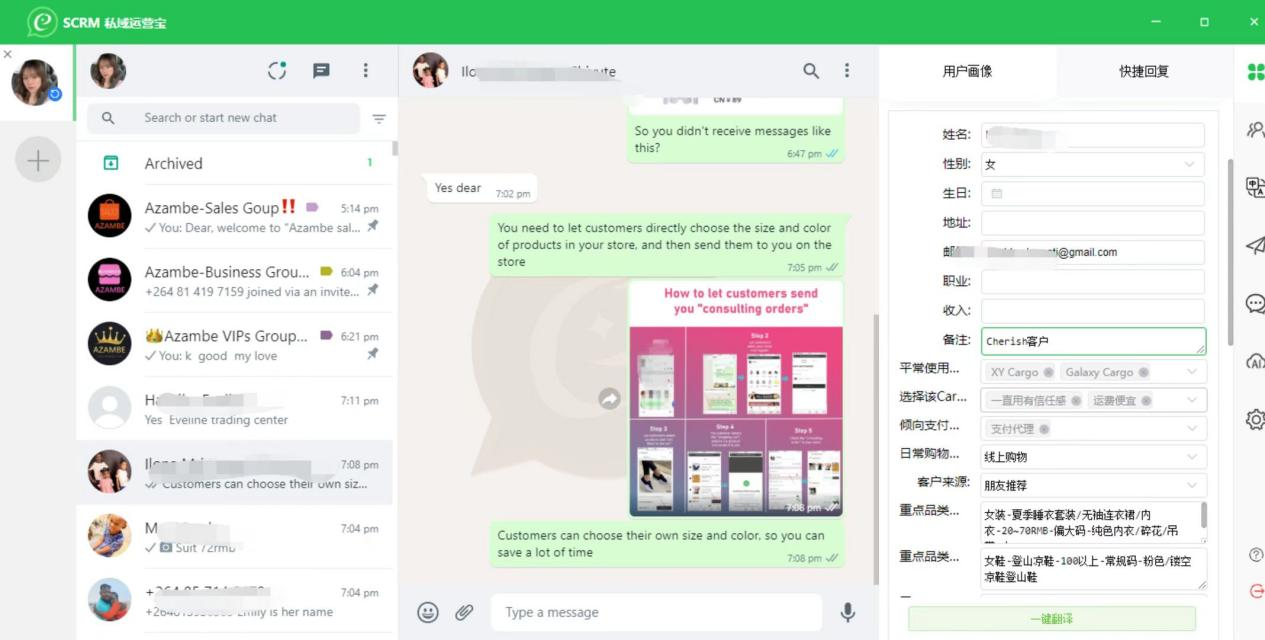
Open the WhatsApp SCRM customer conversation box, and the customer data column on the right has the function of adding collaborators. By adding collaborators, you can achieve:
1. The added collaborator can directly initiate a conversation with the customer on the client;
2. Customer data is updated, and all collaborators can be displayed simultaneously;
3. After any collaborator communicates with customer B, he only needs to write a follow-up record in time, and other collaborators can directly check the customer's latest updates.
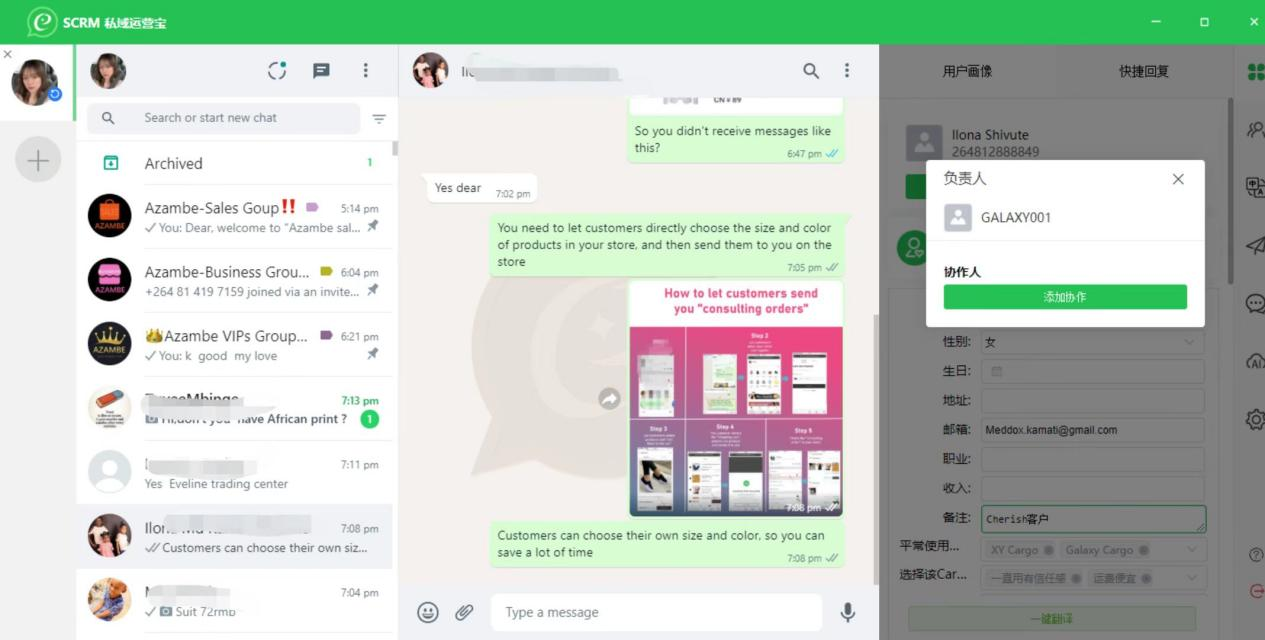
Through internal collaboration functions, eliminate internal information gaps and easily synchronize the latest customer developments. A coordinated action makes internal communication more efficient and maintains a high degree of consistency externally, leaving a good impression of Azambe's professionalism and unity on customers.
WhatsApp SCRM, through the information bar function on the right side of the customer conversation box, helps Azambe salespeople record customer data in a timely and efficient manner, intuitively check and gain insight into customer situations, eliminate problems such as information lag, silos, and out-of-synchronization, improve the efficiency of internal information communication and flow, and eliminate unwarranted internal friction with online digital information collaboration.
In this customer communication scenario of one-to-one intensive chatting, front-line personnel, internal collaboration, and information exchange are empowered to truly achieve refined operations that convert traffic into retention. Based on this, we build an enterprise CDP customer data platform and empower enterprises to build digital marketing.
Summary of Azambe's stock operation model: With WhatsApp SCRM as the core, it conducts refined operations, conducts lead screening, and promotes conversion and repurchase.
All leads, whether they are closed or unsold, need to be deposited into the owned audience pool that can be reached online in real time and at low cost. Taking Azambe as an example, the SCRM system based on WhatsApp can build the entire sales and digital assets on WhatsApp based on front-end customer service and back-end enterprise collaboration.
Based on SCRM and owned channels, Azambe can also do sales collaboration and management, and help enterprises achieve digital transformation with continuous large-scale enterprise data. Every wonderful word, every efficient conversion, and every satisfying experience will help companies optimize their sales capabilities based on data analysis, and even rise to the level of business optimization.
From front-end social media lead mining, to active contact, lead screening, conversion and repurchase, and finally sales collaboration and data analysis based on these four core processes,Azambe can use this to establish a full-link marketing with social owned channels as the core, and in the face of complex and changeable small B customer transactions, it can accurately grasp the needs of more customers and a longer life cycle, and achieve long-term growth of the enterprise.
Summary of Azambe S2b2c success model:
Reconstructing the "people and goods market" of e-commerce, Azambe fully empowers the upper, middle and lower reaches of the industrial chain, and is committed to building a connector between China's supply chain and the African continent, helping Chinese manufacturing go to Africa. Let the African continent experience Made in China and create Africa's leading social e-commerce platform where "everyone can open a store" and "buy by yourself to save money and share to make money".
In this process, from Facebook inquiry treasure (drainage treasure) to WhatsApp SCRMowned-channel operations treasure, from traffic to retention, SocialEpoch empowered Azambe to solve the two major pain points of marketing growth. Azambe (Operation) + SocialEpoch (Technology), the two heroes saw a perfect combination of S2b2c.

- User acquisition stage: With SocialEpoch Facebook Query Bao (Drainage Bao) as the core, a clue intelligence search system with social media account matrix + RPA + automation as the core is established to ensure a continuous flow of living water in the public domain.
- Active reach stage: Social media intelligence, social media contact + matrix account active reach, which reduces the waste of lead circulation compared to traditional emails or phone calls, and can also achieve online real-time contact and reach.
- Owned-channel operations stage: By importing FB social media increments and APP backend work orders into WA SCRMowned-channel operations, the entire business operation is online, socialized and digitalized. Based on the refined operation of SCRMowned channels, we use tags and customer portraits to create a content system and owned-channel operations system based on thousands of people in social owned channels to achieve customer management, data management, sales collaboration and digital marketing.
- Social fission stage: Azambe independently develops client APP. Offline, supply of goods and logistics delivery are realized; online, complete empowerment and services such as payment, independent pricing, social sharing, customer management, mobile wallet, and social distribution are realized. From tool efficiency to the entire supply chain system, small B distributors are empowered online and offline to help each small B realize the beautiful idea of selling goods easily.
05
Azambe S2b2c successful customer cases
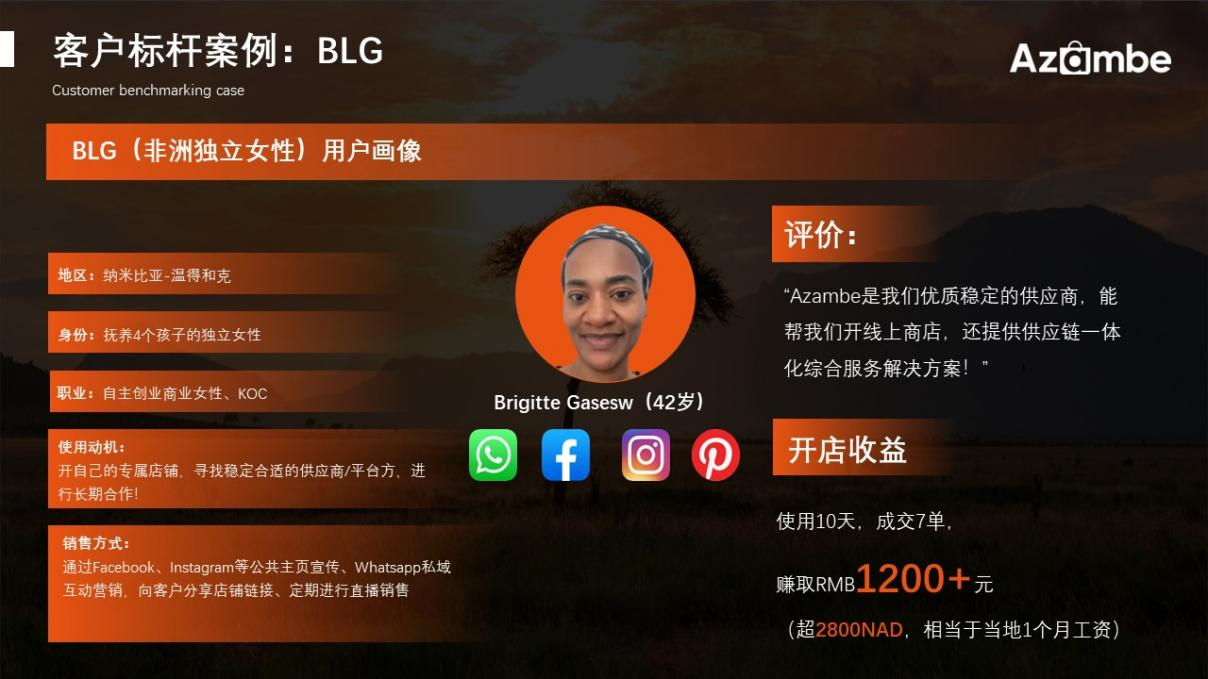
Brigitte Gasesw ("BLG" for short) comes from Windhoek, Namibia, a southern African country. She is a 42-year-old single mother raising four children and a freelance entrepreneur. She conducts online social sales through Facebook, WhatsApp, Instagram and other social channels on a daily basis. She has certain online sales experience and is a professional small B seller.
BLG's main motivations for using Weidian: First, Azambe can provide her with the opportunity to open her own exclusive online store for free; second, she is looking forward to finding a stable and suitable supplier/platform for long-term cooperation.
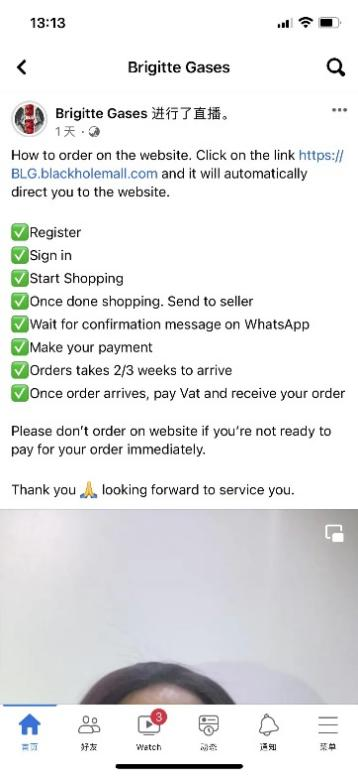
BLG's main customer group: African women, aged between 13 and 50 years old, with demand for fast fashion products such as wigs, clothing, shoes and bags; BLG's social sales behavior (taking Facebook as an example, some social screenshots are attached below) include live broadcasts on Facebook, regularly publishing product pictures, post content, micro-store operation process instructions, micro-store links and Whatsapp contact information on Facebook.


Income from opening a BLG store: Using the Azambe micro store for 10 days, 7 transactions were made, earning over RMB 1,200, which is equivalent to over RMB 2,800 in Namibian currency, which is equivalent to one month’s salary income of ordinary local workers;
BLG's evaluation of Azmabe: Azambe is a high-quality and stable supplier that can help everyone open an online store for free and provide integrated supply chain comprehensive service solutions.
The value of Azambe's success lies not only in its global expansion into Africa using the S2b2c social e-commerce model, but also in its localized operations based on local characteristics and its subtractive marketing based on the domestic owned channel model. In the face of local distributors, Azambe helps them solve the problem of supply stability and provide integrated services; in the face of potential distributors, it fully integrates localized marketing methods to invite development.
The African market is a multilingual environment, and trust in e-commerce still needs to be cultivated. Against this background, Azambe believes that only local people are more suitable for doing local business, and only the content spoken by local people is more suitable for the local cultural environment. Therefore, in addition to inviting Xiao B for distribution, in the face of the incremental expansion of Xiao B, Azambe will also invite local successful Xiao B to share live broadcasts.
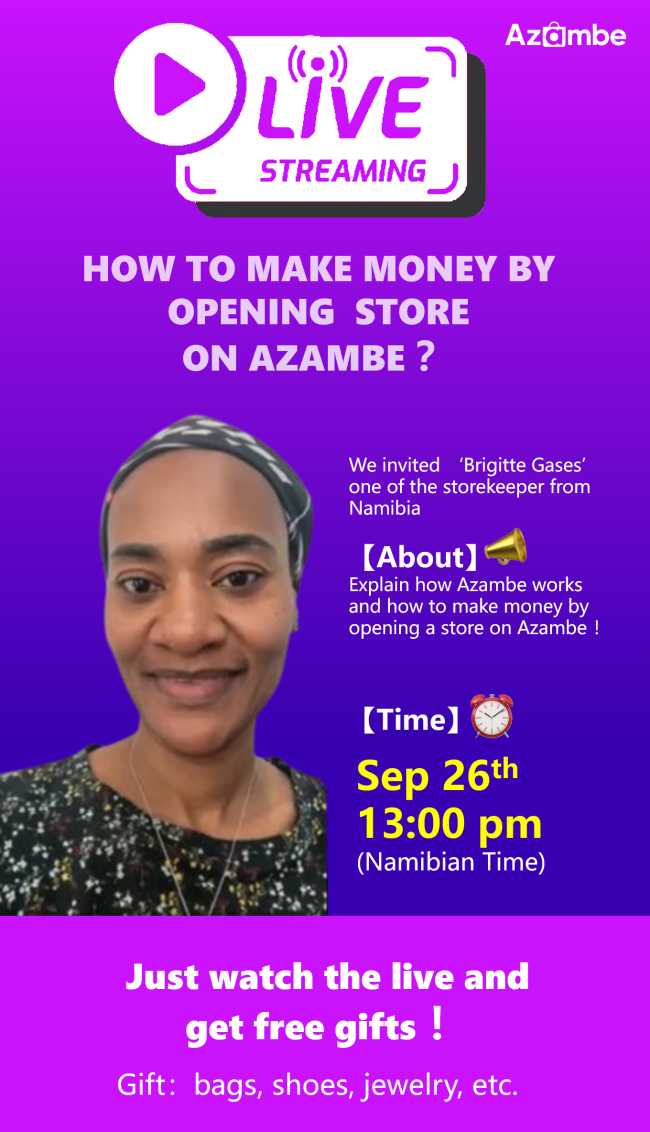
Compared with the brand's own PGC content, such UGC content is more convincing, and the video format also meets the needs of the African people for short, fast content. Through the registration link of the local live broadcast room platform and the establishment of a WA customer service account, the effect of live broadcast sharing can also be maximized. On the basis of fully combining the successful experience of domestic owned-channel operations and S2b2c models, we will reduce user learning costs and acceptance costs, achieve corner overtaking and dimensionality reduction in cross-border global expansion, and create a flexible S2b2c social e-commerce global expansion model with local characteristics.
06
Thoughts and prospects on cross-border S2b2c social e-commerce
The sharing economy is changing our production and life with the trend of decentralization and universal creation:
First, consumers’ attention is becoming increasingly fragmented. This is the result of the extremely rich information in the spiritual world of this era. The development of information technology has made information available to people at their fingertips. Faced with massive amounts of information, consumers' energy has also been dispersed.
Second, consumers are becoming more creative. Thanks to the increasing amount of information and expression techniques that creative platforms carry, everyone's creative abilities are stimulated and are continuously supported and amplified on social media platforms.
Moreover, this trend of fragmentation is irreversible. The Internet will only become more developed in the future. In the Metaverse/Web 3.0, new forms of the Internet will emerge one after another. Information will only become more and more abundant, and consumers' energy will only become more and more dispersed.

Information fragmentation is an irreversible trend, which has also given rise to fragmented marketing methods. Enterprise marketing must get rid of purely centralized and centralized methods. It must transform users into communicators and publicity ambassadors, create an ant army-style communication array, and shape its own large owned channel position. Full-link marketing combining public domain + large owned channel is a necessary strategy for cross-border corporate brand marketing.
There is no owned channel without a public domain. Only incremental publicity and traffic based on the public domain can accumulate the existing operational strength of owned channels. Only full-link marketing that connects the entire user life cycle can integrate digital assets, build a membership system, improve operating scenarios, enrich user touchpoints, realize the growth of brand users' full life cycle value, and enhance corporate operating ROI.
In the cross-border owned-channel marketing scenario, the S2b2c social e-commerce model can be implemented in two major scenarios:Social distribution S2b2c and social new retail.
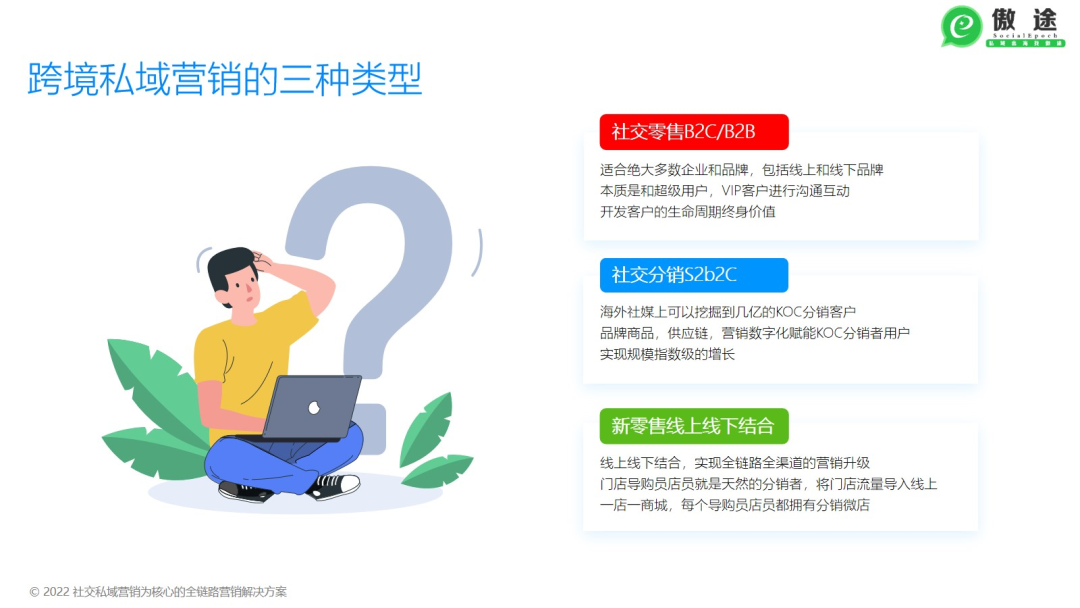
Social Distribution S2b2cIt refers to the purely online S2b2c social e-commerce model. Chinese suppliers/brands achieve distribution through 500 million overseas small B distribution groups. A large number of small B groups such as global small shop owners/KOL networks/community group owners/knowledge moms are in urgent need of the empowerment of the S platform. Enterprises can tap hundreds of millions of KOCs on overseas social media, and empower KOC small B distributors through branded products, supply chains, marketing digitization, etc., to achieve exponential growth in scale.
The latter is a combination of online and offlineCross-border social new retailScenario, many domestic brands have physical store channels overseas. Through assistants such as clerks/shopping guides/store managers, customers of stores/chain stores can be added to the WhatsAppowned channel to form the company's online user pool (offline users go online), and more user data and transaction orders can be obtained. This model is suitable for enterprises that combine online and offline operations to achieve full-link and omni-channel marketing upgrades.
Store shopping guides/clerks themselves are natural distributors. By channeling store traffic online, one store, one mall is realized. Each shopping guide/clerk owns a distribution micro-store, which expands the profit range of store services from a few kilometers to dozens of kilometers.
The sharing economy is changing the global economy and the lifestyle of entrepreneurs at an unprecedented speed. We have reason to believe that the S2b2c model will inevitably rise and become the most important retail business model in the future. Through SaaS digital upgrade, more Chinese suppliers/Chinese brands can be empowered, and exponential growth can be achieved through many overseas distributors. This is a good opportunity for differentiation in brand global expansion.
Case Honor: 2022 and the 4th Unique Awards "Extraordinary Award" - Best Overseas Owned-Channel Operations Award in the E-commerce Industry.