In this article, SocialEpoch will focus on explaining the relationship between owned-channel operations and cross-border platforms, as well as how owned channels feed back the public domain and help platform merchants increase their revenue. Please check below:
Part.01 Why are more and more platform sellers choosing owned-channel operations+?
Passive reason: regulatory policy adjustments for cross-border platforms
The Amazon account suspension fine incident that began in May this year is undoubtedly the most vivid example. There are different opinions on the reasons for account suspension fines.Teacher Wei Zhe from Jiayu CapitalA more convincing answer was given: the premise of the account suspension fine must be that it infringes on the interests of the platform, consumers or other merchants.
Infringed upon the interests of the platform, banned!
Violates the interests of consumers, banned!
Infringes upon the interests of other white hat merchants, banned!

The Amazon platform also has a relatively distinctive feature: consumer interests come first. Under the guidance of this idea, in order to fully safeguard the consumer experience and platform interests, there must be "countermeasures for merchants and policies for the platform." When illegal reviews increased, the platform made policy adjustments; when the platform's regulatory policies were adjusted, many sellers began to look for global expansion methods outside the platform: such as independent websites, owned-channel operations, etc.
This is the passive reason why sellers turn to owned-channel operations.
Reason for initiative: strategic value of global operations
At present, the sources of traffic are becoming more and more clear: public domain, owned channel and other domains. The public domain is relative to the owned channel, and other domains are other people's owned channels. Cross-border platforms, such as Amazon, Alibaba International Station RTS, etc., are typical public domain pools.
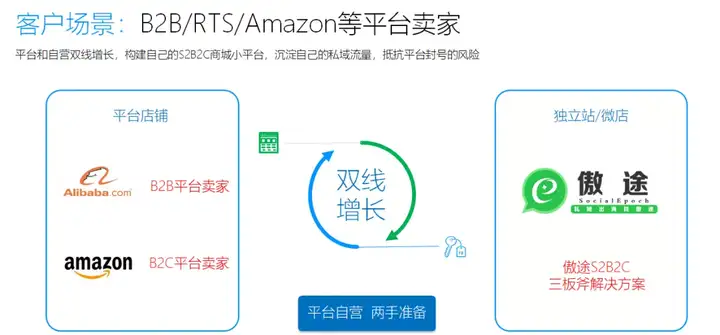
The public domain is great, but traffic must be paid for. This is a very real problem. Therefore, global operations have become a strategic decision for many enterprises and merchants.With one hand, we focus on the public domain, tap platform traffic, and make full use of the natural advantages of the platform, such as payment and logistics; on the other hand, we focus on owned channels to build our own owned audience pool, reach N times directly at low cost, reduce operating costs, and promote customer repurchase, old customer recommendations, etc.

Public owned channels are being used on both sides, and platform owned channels are growing in both directions. This is the reason why platform sellers begin to focus on owned-channel operations.
Part.02 How do platform sellers use owned channels to boost revenue growth?
Build an owned audience pool and use owned channels to feed back the public domain
For Amazon, they are naturally happy to attract traffic from other channels. I believe you must have been to XX merchants/some cats/some east discount groups. This is the simplest and crudest owned channel to feed back the public domain.
Overseas, you can also use WhatsApp to build similar discount groups/sharing groups/wool groups to attract traffic to Amazon/International Station RTS/AliExpress/Meikeduo/Shopee and other platform stores.

As a seller, you cannot guarantee that customers will stay in your store forever, but you can be sure that customers spend most of their online time in social applications. This is why social owned channels can feed back into the public domain. This feedback effect is not only applicable to platform stores, but also to independent websites.
Direct transactions in owned channels, distribution fission improves ROI
This is why many merchants carry out global operations. The advantages of the public domain platform cannot be ignored, nor can the N-time low-cost direct access characteristics of owned channels be ignored. Therefore, while building a platform, we also build owned channels to achieve self-operated global growth of the platform and avoid the risks of operating on a single platform. This is also a new approach adopted by many platform-based sellers after the wave of bans.
Direct transactions on owned channels are also more friendly to merchants and consumers:There is no need to jump to APP or other platforms, orders can be placed directly, shortening the user's purchasing path and improving the user's shopping experience.You can also use consumers' social circles for self-propagation, making full use of everyone's social value and lifetime value, and naturally proceed from conversion to repurchase to recommendation.
In addition, the transaction environment for overseas owned channels will become better and better: WhatsApp has successively opened payment functions in India and Brazil, and launched KFC ordering in South Africa... These "WeChat-like" actions also demonstrate WA's never-ending desire for social monetization.
Compliance assessment of brand planting, overseas owned channels have many ways to play
If the above two points are the direct effects of owned-channel operations on traffic conversion, then brand planting, compliance assessment, digital asset accumulation, etc. are their strategic and long-term value to brand merchants.
Platform transactions and owned channel compliance evaluation can be said to be a light in the darkness for Amazon sellers who have been greatly affected by account suspension fines. After all, for Amazon operations, evaluation is an indispensable link, and its quantity and ratings also determine the listing’s order conversion. With the help of the owned audience pool, platform sellers can implement real-person compliance assessments and invite consumers to leave reviews based on their real purchasing experience.
Content planting is publicity for businesses, a process of building consumer awareness and building brand image, and there is a long way to go. During the cold start period, many domestic brand merchants may use hundreds or thousands of Xiaohongshu and Weibo accounts to build public opinion, while global expansion brands can similarly use owned channel communities for preliminary publicity and brand planting.
Owned channels are also the digital assets of every merchant. Because of the seamless communication with customers, there will be an intuitive digital basis for A/B testing, product update iterations, marketing operation adjustments, etc. of the enterprise. Of course, there are many ways to play overseas owned channels. I believe that in the future, platform merchants will achieve more exciting and valuable practical expansion with the help of owned channels.
Part.03——Summary——
Due to the tightening of platform regulatory policies and the strategic value of global operations, more and more platform sellers are beginning to focus on owned-channel operations. Being an overseas owned channel can provide cross-border sellers with many advantages such as feeding back into the public domain, directly converting transactions, growing brands, conducting compliance assessments, and accumulating digital assets. In the future, social owned channels will become an indispensable configuration for many platform sellers.
For more practical cases of overseas platform-based sellers, owned-channel operations, methods of diverting traffic, etc., scan the customer service QR code on the left side of the picture below to communicate directly.