S2B2C is described by Alibaba Chief of Staff Zeng Ming as a new model that will replace B2C e-commerce in the next few years and the first breakthrough innovation model in the smart business era. Through the S supply chain platform, B dealers are empowered to jointly serve C customers, reducing costs for S, increasing profits for B, creating a good shopping experience for C, and achieving differentiated sales growth for enterprises.
After the domestic S2B2C model became popular, the development of cross-border S2B2C also followed closely behind. It is worth noting that among the three major types of cross-border owned-channel marketing, S2B2C can empower two types of corporate merchants: online distribution brands and new retail brands.
This article will firstFrom the necessity of all-domain + all-link marketing, it extends to the essence and differentiated value of the cross-border S2B2C model, as well as practical case studies of the S2B2C model for cross-border online brands and cross-border new retail brands.. Below, Enjoy:
1. The necessity of global + full-link marketing
From the incremental market to the existing market, whether it is domestic sales or cross-border sales, corporate merchants have to face two prominent problems:First, user acquisition is becoming more and more difficult, and second, advertising costs are getting higher and higher.. We have also introduced these before. The disappearance of dividends in the public domain traffic/Internet era and the involution and bidding of merchant operations have made these problems particularly obvious. For cross-border merchants, they face significant user growth problems, such as: B2B cross-border sales are based on single orders, B2C platform supervision is strict, and B2C independent website customers are difficult to retain, etc.
In the era of social marketing, if cross-border enterprises want to get rid of these problems, they must rely on the power of social owned channels to achieve refined operations, give full play to users' lifetime value LTV and social value, achieve conversion, repurchase, distribution referrals, etc., reduce customer acquisition costs from the source of traffic, and enhance user stickiness. This applies not only to overseas social e-commerce, but also to independent merchants, platform merchants and cross-border sales B2B merchants.
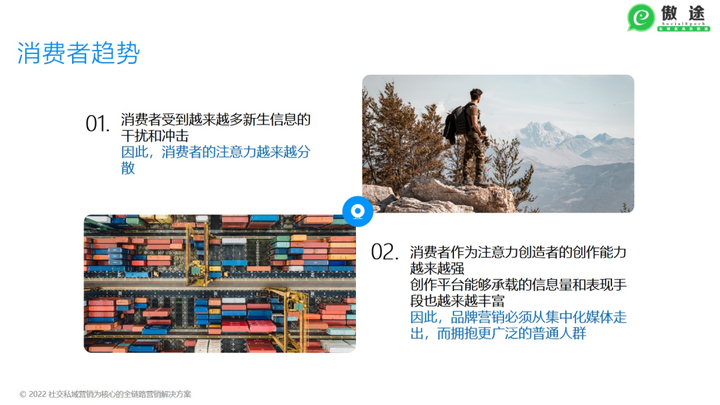
On the other side, the consumer side is also catering to two obvious changing trends in this era:First, consumers’ attention is becoming increasingly fragmented.This is the result of the extremely rich information in the spiritual world of this era. The development of information technology has made information available to people at their fingertips. Faced with massive amounts of information, consumers' energy has also been dispersed.Second, consumers are becoming more and more creative.. Thanks to the increasing amount of information and expression techniques that creative platforms carry, everyone's creative abilities are stimulated and are continuously supported and amplified on social media platforms.
Moreover, this trend of fragmentation is irreversible. The Internet will only become more developed in the future. In the Metaverse/Web 3.0, new forms of the Internet will emerge one after another. Information will only become more and more abundant, and consumers' energy will only become more and more dispersed.
Information fragmentation is an irreversible trend, which has also given rise to fragmented marketing methods.Enterprise marketing must get rid of purely centralized and centralized methods. It must transform users into communicators and publicity ambassadors, create an ant army-style communication array, and shape its own large owned channel position.
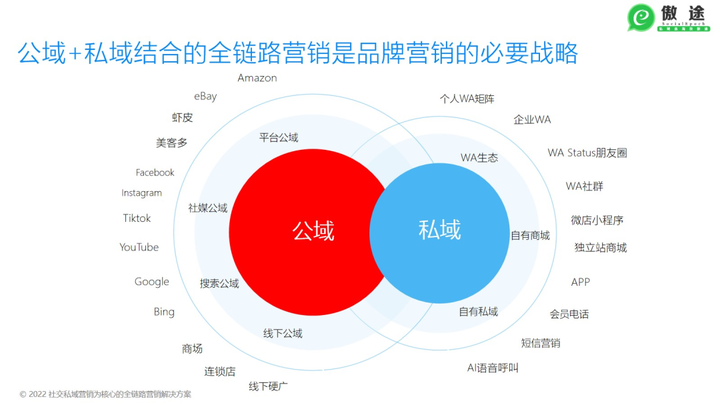
From this,Full-link marketing combining public domain + large owned channel is a necessary strategy for cross-border corporate brand marketing. SocialEpoch's slogan is "owned channel global expansion, find SocialEpoch", but there is no owned channel without a public domain, and only incremental publicity and traffic based on the public domain can accumulate the stock operation power of owned channels. Only by connecting the full-link marketing of the entire user life cycle can we integrate digital assets, build a membership system, improve operating scenarios, enrich user touch points, realize the growth of brand users' full life cycle value, and improve corporate operating ROI.
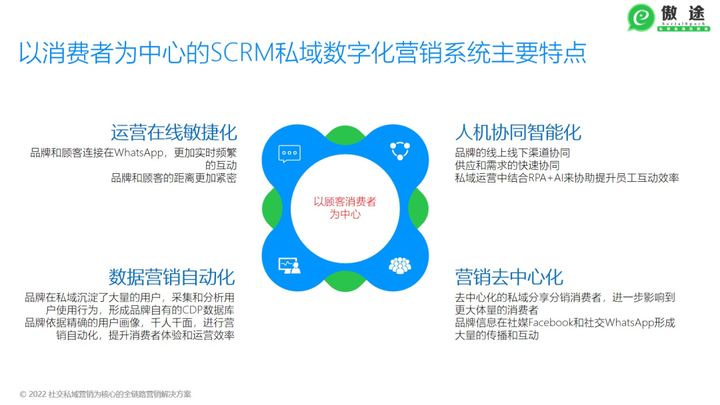
SocialEpoch has also been established for cross-border enterprisesConsumer-centered overseas SCRMowned channel digital marketing system, focusing on users and consumers, building a full-link solution with owned-channel marketing as the core, and realizing for cross-border enterprises:
- Operational online agility:
- Human-machine collaborative intelligence;
- data marketing automation;
- Marketing decentralization.
To sum up, on the one hand, enterprises are troubled by the current situation of difficulty in user acquisition and high delivery costs; on the other hand, the trend of fragmented information and enhanced creative capabilities on the consumer side. In this "difficulty and change", fragmented/decentralized marketing methods have become strategic choices for cross-border brands.Full-link marketing combining public domain + large owned channel is a necessary strategy for cross-border corporate brand marketing。
2. Differentiated advantages of cross-border S2B2Cowned-channel marketing
Above, we have elaborated on the strategic necessity of cross-border owned channel + public domain full-link marketing. To subdivide cross-border owned-channel marketing, there are three major types that we must pay attention to:
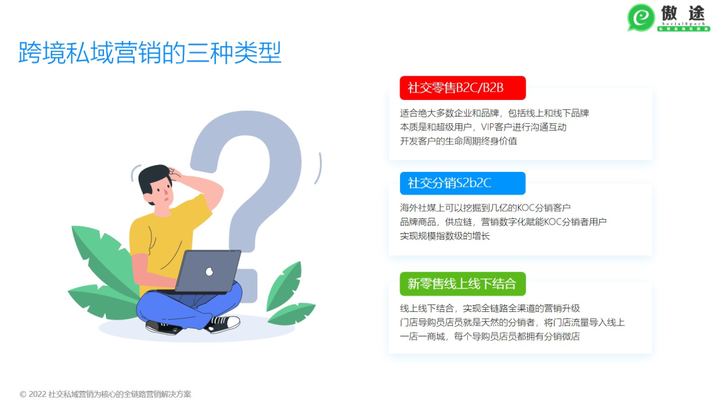
Type 1: Social retail B2C/B2B
This type is consistent with most online and offline brands. Its essence is for enterprises to communicate and interact with super users/VIP customers to develop the lifetime value of customers.
Type 2: Social Distribution S2B2C
Enterprises are looking for distribution KOC small B groups with social value. Hundreds of millions of KOC can be mined on overseas social media, and KOC distributors and users are empowered through branded products, supply chains, marketing digitization, etc., achieving exponential growth in scale.
Type 3: New retail online and offline integration
It is suitable for enterprises that combine online and offline operations to achieve full-link and omni-channel marketing upgrades. Store shopping guides/clerks are natural distributors. By channeling store traffic online, one store, one mall is realized. Each shopping guide/clerk owns a distribution micro-store, which expands the profit range of store services from a few kilometers to dozens of kilometers.
Among them, the S2B2C model can be applied to the latter two types of scenarios:
One is the purely online S2B2C model. Chinese suppliers/brands achieve distribution through 500 million overseas small B distribution groups. A large number of small B groups such as global small store owners/KOL networks/community group owners/knowledge moms are in urgent need of the empowerment of the S platform.
One is the cross-border new retail scenario that combines online and offline. Many domestic brands have physical store channels overseas. Through clerks/shopping guides/store managers and other small Bs, customers of stores/chain stores are added to the WhatsAppowned channel to form the company's online users, who can obtain more user data and transaction orders.
The actual combat methods of the two types of scenarios will be detailed in the third and fourth parts of this article. Here we will analyze the essence and differentiated value of the S2B2C model in detail.
2.1 What is S2B2C?
Alibaba Chief of Staff Zeng Ming once mentioned, “The S2B2C model will be a new model that will replace B2C e-commerce in the next five years" and "the first breakthrough innovation model in the era of intelligent business."
Regardless of merchants or consumers, everyone is full of expectations and longing for the future C2B business model. The ideal C2B model cannot immediately replace the existing business model. In this transitional stage, with the continuous development and progress of business, a new transitional model-S2B will naturally be derived.
S2B2C can also become C2B2S. S refers to the supply empowerment platform. C is not served through one big B, but connected through many small Bs. The small Bs then use S's supply empowerment platform to complete services.
In other words, Little B cannot independently complete the service to C customers without the support of S. Little B is a new species growing on the S supply empowerment platform, and there are tens of thousands or hundreds of thousands of them. By accessing the supply empowerment platform provided by S, they directly connect and interact with customers. Their core value is to complete real-time, low-cost interactions and services for customers.

The S platform must ensure quality and process efficiency, and the most important thing is to allow small B to independently exert their best ability to reach and serve customers. S provides standardized supply chain services and SaaS digital system support to empower Little B; Little B has a certain degree of personalization and connects to consumer C through a WhatsAppowned channel to provide personalized services.
2.2 The core innovation points and differentiated value of the S2B2C model
Its core innovative feature is that S and small B jointly serve C, which is much more valuable than a separate small B or a separate big B directly serving C customers. Their common services have two meanings:
- When small B serves customers C, it needs to call on many enabling services provided by S, such as supply chain integration, payment and logistics integration, digital marketing SaaS empowerment, and intelligent data products, etc.; these enabling services can only be provided by S, because its investment and professional threshold are relatively high, which small B cannot afford.
- The process of Little B serving C is also a process in which S participates and obtains feedback in real time, which can improve S's empowering service to Little B and improve the user experience of C's customers. In this process, the urgent need is to realize digital SaaS operations, online management, automatic collaboration, etc., so as to better serve C customers.
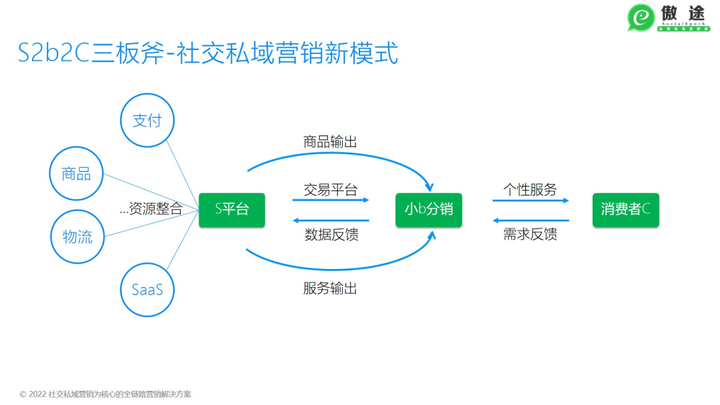
Different from the Internet platform model, the S empowerment platform may no longer be a traffic entrance, because it does not promise to provide traffic to small B and ensure the survival of small B. Each little B has his own circle of friends, and he can influence a group of people, and use his own circle to create an exclusive owned audience pool.
The core key to the success of the S2B2C model is how to find a large number of small B's with their own owned audience to cooperate with, and then provide a complete platform empowerment for the small B's, giving full play to the independent capabilities of the small B's to achieve successful transactions.
The organization of S2B2C model is similar to "Large middle desk, small front desk"In this way, even if general B2C companies carry out similar optimization and iterations of the organization, they cannot fundamentally change it and it is difficult to directly upgrade to the S2B2C model. This also gives innovators a good opportunity to enter the cross-border market.
2.3 The empowerment provided by S for small B in the cross-border S2B2C model
- SaaS tools. This is the most basic. S needs to connect and serve Little B through SaaS tools, and build an exclusive owned audience pool for Little B based on WhatsApp. At the same time, it also needs to use the SaaS-based WhatsApp owned channel management system and the KocShop fission micro-store system to help Little B use WhatsApp to better manage and interact with the C of the owned audience, and to complete transactions conveniently and efficiently.
- Supply chain centralized procurement. Supply chain integration is an important part of the empowerment provided by S, and it has a very big advantage compared to Small B's own scattered procurement behavior. Prices are lower and product quality is more controllable.
- Common quality assurance. Through network digitization and onlineization, Little B can provide consumer C with a unified user experience and quality delivery through the platform provided by S. Of course, S and Little B can also co-create and cooperate. They can have a dual-brand strategy, with S’s brand and Little B’s IP brand.
- Network collaboration. The S platform can collaborate with many upstream suppliers and integrate into a complete empowerment platform to assist small B, thereby serving consumer C well. For example: integrating factories, brands, SaaS system services, warehousing, distribution, payment, customer service, training, content marketing and other links into one to jointly empower small B distributors. This greatly lowers the threshold for small B retail. Physical store owners, KOL internet celebrities, community leaders, mothers and other small B groups can join and participate in distribution. Based on this basis, this small B group can exceed the scale of millions and millions, and can greatly drive S's order sales.
- Data empowerment. All interactive data and transaction data are centralized on the S platform. S can use its own resources, talents and financial advantages to conduct big data analysis, provide small B distribution with a detailed portrait of consumer C, and achieve more accurate distribution decisions.
- Training and marketing empowerment. The S platform should provide standardized training services to help Xiao B become familiar with the supply chain, familiar with the SaaS system and get started quickly, and familiar with the basic methods of community owned-channel marketing and order closing. At the same time, the S platform must continuously provide content marketing materials so that the Xiao B homepage group can continuously output creativity, activate the community, and convert orders.
In other words, in the cross-border owned-channel marketing scenario, S2B2C can achieve differentiated empowerment for pure online brands and new retail brands. By giving full play to the social value of thousands of small distribution groups, it can exponentially amplify the transaction scale of enterprises.
3. Online Brand S2B2C Practical Strategy
After talking about the strategic necessity of cross-border owned channel + public domain marketing and the differentiated value of the S2B2C model in cross-border owned-channel marketing, this part will focus on the practical strategies and cases of the S2B2C model for cross-border online brands.
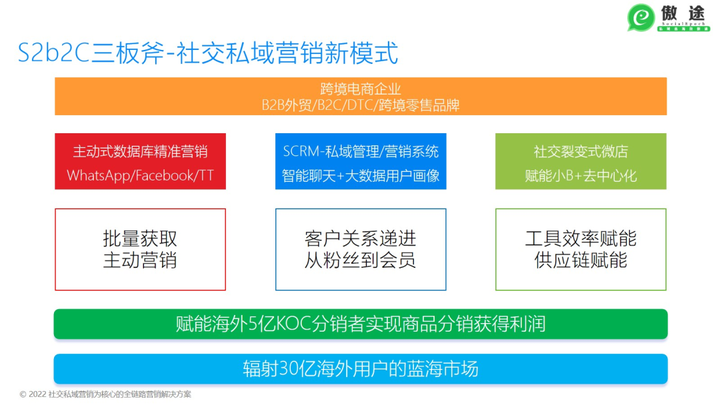
SocialEpoch simplifies the entire cross-border S2B2C model. In the SocialEpoch S2B2C three pillars - social owned-channel marketing form, we integrate the entire S2B2C into three key stages: batch acquisition of active marketing, progressive owned-channel operations based on customer relationships, and decentralized fission empowerment.Whether it is cross-border sales B2B, B2C, DTC or cross-border retail brands, you can use S2B2C to reach overseas KOC distributors with a total number of 500 million, distribute products and achieve growth.
Let us combine two cases to describe how SocialEpochS2B2C achieved rapid growth for two pure online brands.
Case 1: Meesho
Meesho can be rounded off to be understood as the Indian version of Aiku, an old customer that SocialEpoch served a few years ago. If you don’t know much about Meesho, you can read this article:Social e-commerce unicorn meesho raised US$570 million, and overseas S2B2C is booming
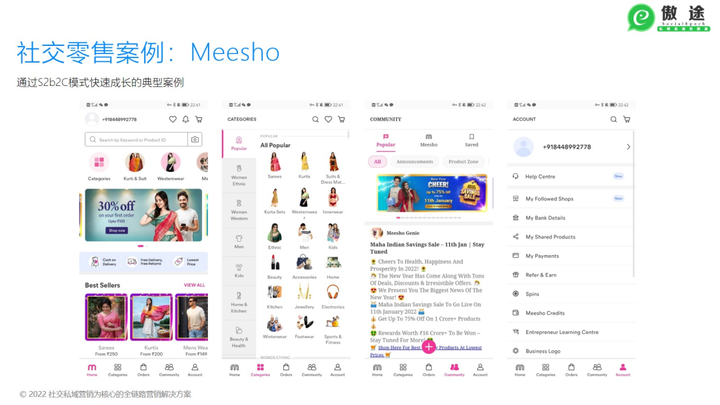
Meesho is a typical pure online social retail S2B2C case. Its early customer acquisition growth method is very simple. It collects small B information on a large number of platforms to establish connections, and then implements IP building and relationship progression for the small B crowd to achieve rapid growth of customer acquisition.
In this process, there are two keys to success or failure:
The first is the empowerment of Xiao B’s personal IP creation and community operations: a large amount of copywriting and creative content are the core. On the social platform for consuming content, you can create a personalized and warm social business card for Little B. You can display products in a variety of ways such as graphic, text, video, H5, etc. You can also use social red envelopes like "A penny is love" to open chat boxes and get contact information. You can also use interesting and useful interactive games to retain customer data and enhance stickiness.
The second is the empowerment of profit sharing mall: through the profit sharing mechanism driven by profit, small B can be firmly locked in and not lost.. This is a sublimation of the basic functions of an online mall combined with the S2B2C model, which provides small B with exclusive distribution results and profit sharing, cash withdrawals, etc. Combined with the above analysis of the S2B2C model, it is not difficult to see the digital value of such SaaS tool empowerment to the S platform.
Case 2: Vaper KUKE
Vaper KUKE uses a multi-level distribution S2B2C model. Users of this type of atomizer products basically have typical social circle value. To put it bluntly, friends of smokers are basically smokers, so users are a small B group that companies cannot miss. In addition, another group B with small value is store clerks.
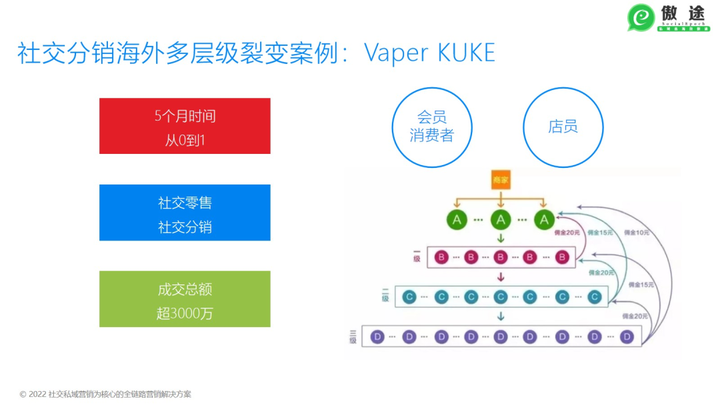
Multi-level fission distribution has achieved exponential user growth for Vaper KUKE. And unlike China, the multi-level distribution mechanism in many overseas countries is legal and can be developed up to ten levels. It can be said that it provides a good opportunity for differentiation for S2B2C social distribution of cross-border enterprises.
The above is the empowerment and gameplay of SocialEpochS2B2C for two customer cases of cross-border social retail and social multi-level distribution. For more details, please consult the customer service at the bottom of the article.
4. New retail brand S2B2C practical strategy
New retail must be familiar to everyone. Now, cross-border companies have begun to gradually enter the new retail era: overseas, many companies have begun to deploy offline stores, from Amazon's "4-Star", fresh food supermarket "Amazo Go" to SHEIN's eye-catching pop-up stores, cross-border e-commerce has ushered in the new retail era.
Different from the traffic problems of purely online brands,New retail companies will have problems such as offline store service scope being limited by geographical location, store customers leaving immediately when they come, leaving no contact information, loss of on-demand ordering customers, and inconsistent online and offline marketing activities.Now, with the combination of SocialEpochS2B2C, these problems can be easily solved.
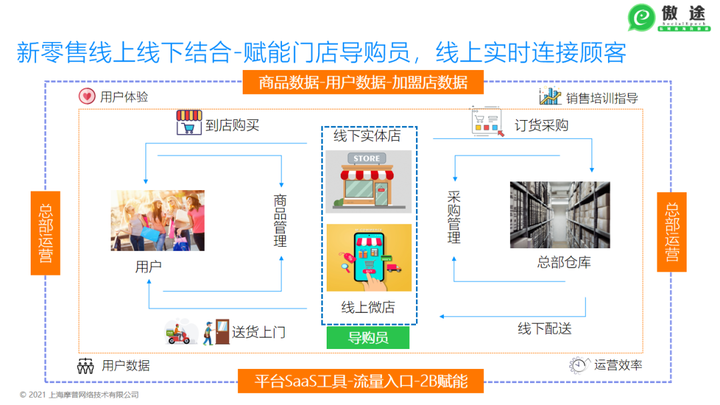
Here, let us use two scenarios to explain the actual combat strategy of the S2B2C model of cross-border new retail online and offline integration of brands.
Scene 1: Thousands of stores, one store and one mall
Transform traditional stores into new retail digital stores. Each store employee is equipped with exclusive social contact information for distribution, and an exclusive community for the store is established.
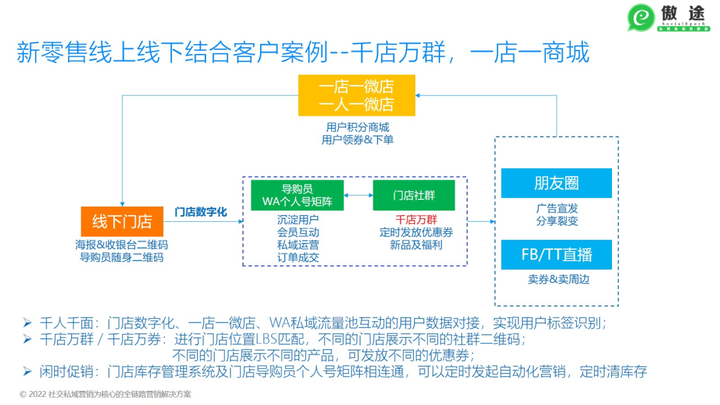
This enables one store, one mall + thousands of stores and thousands of groups: each store can perform location LBS matching and establish an exclusive online micro store based on store information. Different stores can display different community QR codes, different products, and issue different coupons.
By connecting online and offline through digital methods, retaining customer data and transforming all store employees into online distributors, the scope of store service will be expanded from the original two or three kilometers to dozens of nearby kilometers, fully expanding the service efficiency and scope of a single store.
Such online digital stores can also use the S2B2C model distributed by clerks to implement free-time promotions, out-of-season promotions, regular inventory clearance, etc., to increase the operating value of new retail stores.
Scenario 2: New retail store integrating omni-channel and multi-touch points
In such a new retail system, enterprises reach users through all channels and multiple touch points, including online, offline, social media, Google, owned channels, and the public domain. This form of user access also allows enterprises to establish a collaborative combat system of headquarters + stores.
In the digital stores of such enterprises, store shopping guides also play the role of distributors. But unlike the previous case, behind them, the headquarters will establish a powerful think tank - the owned-channel operations team, which will exclusively provide professional and standardized creativity and content, empower services for store owners, and provide a steady stream of "guns and ammunition." Forming a new retail store service form that integrates online and offline, headquarters and stores.
The above is our analysis of the S2B2C model of cross-border new retail brands, includingThousands of stores, one store, one mallandNew retail store with omni-channel and multi-touch point integrationTwo different actual combat styles.
5. S2B2C model – differentiated opportunities for cross-border brands
The sharing economy is changing the global economy and the lifestyle of entrepreneurs at an unprecedented speed. We have reason to believe that the S2B2C model will inevitably rise and become the most important retail business model in the future. Through SaaS digital upgrade, more Chinese suppliers/Chinese brands can be empowered, and exponential growth can be achieved through many overseas distributors. This is a good opportunity for differentiation in brand global expansion.
The content of this article comes from the live broadcast shared by SocialEpoch CEO Chen Jiujiu Scott on the Hugo platform with the theme "Analysis of S2B2Cowned channel model of cross-border brand marketing". Send a private message to customer service to view the replay and learn more about the scenario play and implementation experience of the cross-border S2B2C model.