On a sunny morning, Melina from Orlando, Florida, skillfully opened WhatsApp, found a Chinese friend she met three months ago, and placed an order for 200 pieces of false eyelashes. She is stocking up on her Beauty Bar.
In the past, she had to call a local distributor to order, but now she can get the same supply at a lower price and the delivery time is about the same as before.
Since the epidemic, many small businessmen in the United States like Melina have learned to order the products they need through the Internet. They have bypassed first-level distributors and still ordered the same products but received more generous profits. More and more B2B transactions are taking place online, and McKinsey & Company reports that by 2022, about 65% of B2B companies across various industries will conduct transactions entirely online.
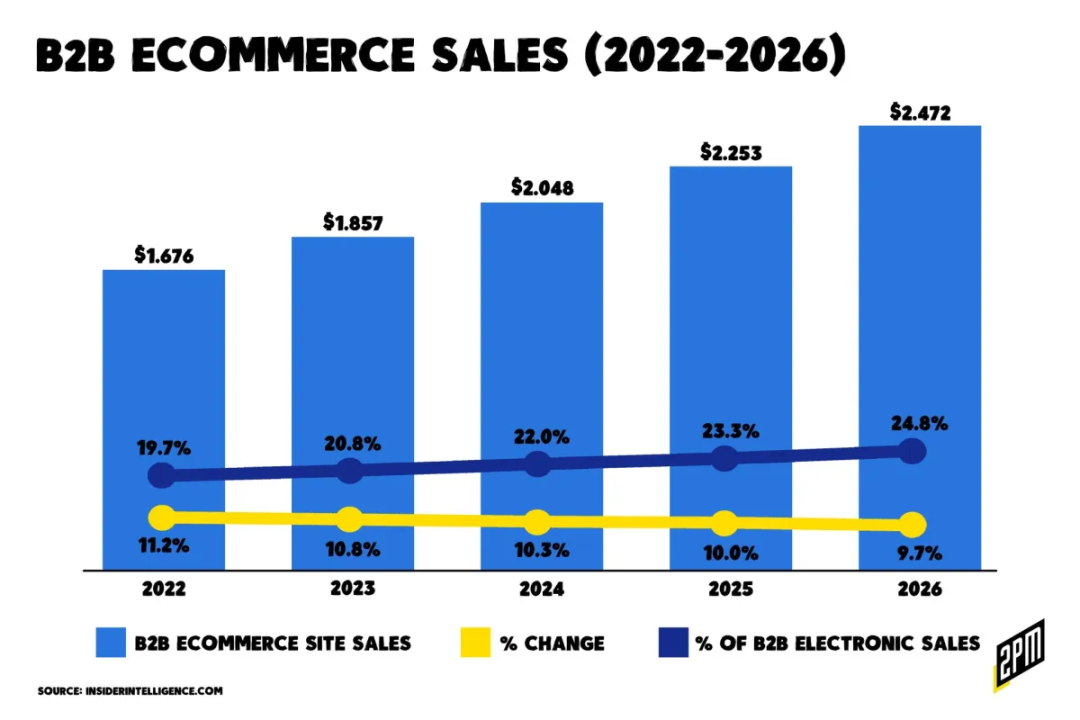
In the United States, an important target market for cross-border e-commerce, the B2B e-commerce market exceeds one trillion US dollars. Data predicts that U.S. B2B e-commerce sales will reach US$1.6 trillion by the end of 2022, and will exceed US$2.47 trillion by 2026.
Perhaps, the future of cross-border e-commerce growth belongs to B2B e-commerce.
01
Continuously growing B2B e-commerce market
The B2B model occupies a very large market share of global transactions. Taking the U.S. market as an example, B2B sales account for one-eighth of the U.S. economy. Data show that the U.S. B2B market will reach US$16.3 trillion in 2021.
Under the influence of the epidemic, physical retail has shifted to omni-channel retail on a large scale, promoting the development of online B2B business. According to statistics, B2B e-commerce transactions in the United States account for approximately 10% of total B2B sales, which means that total B2B e-commerce sales in the United States will exceed US$1.6 trillion in 2021. By 2026, the North American B2B e-commerce market will exceed US$2.47 trillion.
In addition to Amazon B2B business Amazon Business and Alibaba International Station, which is well known to Chinese sellers, B2B e-commerce platforms active in the US market include WholesaleCentral, ThomasNet, Kinnek, B2B tradeholding, B2W Companhia Digital, ChinaAseanTrade, DIYTrade, EC21, etc.
In addition, regional B2B e-commerce platforms are springing up around the world. In 2022 alone, the B2B e-commerce platforms that have received financing include: EkkBaz and Eezee in Singapore, Soptle and Groyyo in India, MaxAB and Cartona in Egypt, Omnibiz in Nigeria...
With the development of B2B e-commerce platforms, the ways for retailers to discover and purchase products have become more diverse. In the past, small American store owners like Melina often communicated with fixed sales managers over the phone to purchase products, or logged into product portals to purchase products themselves. Now they no longer blindly repurchase higher-priced products from distributors, but have learned to browse e-commerce platforms such as Amazon to discover similar products at lower prices.
Digital Commerce 360's March 2022 research on B-side buyers showed that 52% of respondents said they would go to "e-commerce websites because they have more choices." 57% of buyers said they purchased more products from e-commerce platforms during the epidemic.
McKinsey & Company reports that approximately 18% of B2B revenue comes directly from e-commerce, higher than phone calls, emails, and video conferencing. By 2022, approximately 65% of B2B companies across various industries will conduct transactions entirely online.
Another obvious trend is that more and more consumer brands use B2B e-commerce platforms as new sales channels.
In September 2022, Budweiser Brewing Group announced with a high profile that its B2B e-commerce platform BEES would be launched in the UK. Budweiser hopes that the BEES platform will provide retailers with a seamless order experience and communication, and business owners will be able to browse products, place orders, set up deliveries, process invoices, etc. through the platform. Brian Perkins, President and CEO of Anheuser-Busch Western Europe, said: “By harnessing the power of data and technology, we increase the productivity of all businesses in our ecosystem. "
Some Chinese merchants, on the other hand, are just the opposite. They first set up stores on e-commerce platforms or serve as suppliers to American distributors, and then gradually develop offline channels.
02
B2B business on social media
The development of social e-commerce has provided new purchasing channels for young store owners like Melina who are keen on social media. She shared her daily work routine on Facebook and showed off the false eyelashes she sells, and this information was captured by Dushan in Pingdu City, China through Salestech tools.
The products produced by the cross-border sales false eyelash factory run by Duchamp just met Melina's requirements. After several exchanges, Melina discovered that Duchamp's factory was the supplier of local distributors in the United States, so she gave up the American distributor and placed an order directly with Duchamp.
Data shows that about 46% of B2B buyers currently use social media to learn about alternative products, and 35% obtain information through social media to place orders. And this also provides "Duchamps" with new cross-border B2B business ideas.
Before the epidemic, cross-border sales factories often found business partners through exhibitions. Du Shang, who runs a cross-border sales false eyelash factory in Pingdu City, said: "When my father was in charge of the factory, he had to send people to take products to different places to participate in exhibitions almost every month. He had to guard the booth and wait for cross-border sales merchants to inquire, which not only cost money but also took time."
Affected by the epidemic, many cross-border sales factories have moved their business online. The false eyelash factory where Duchamp is located has also opened a store on the Amazon platform. But soon, Duchamp discovered that the business logic of B2C and B2B was very different. Marketing logic and brand logic had to be learned from scratch. It was not easy to transform into a B2C brand.
As a result, Duchamp changed his mind and began to publish product information in Facebook groups. He also used new tools to explore product needs on Facebook and Instagram and find overseas B-end customers. "It is safer to do B2B business. We originally found B-side cross-border sales companies to sell the goods. Now we directly find overseas B-side customers online, and the profit margin is larger than before."
However, Duchamp found that some big orders still came from regular customers who had established diplomatic relations with the front line. "Recently, I saw in the news that many local companies are organizing global expansion to grab orders. We also want to go out and have a look together."
Zhao Yubing, who is in Xiamen, has more experience in social media gameplay. He said: "You can open your mind and not only post product information on Facebook groups, but you can also try TikTok and Redit. Redit is called the overseas version of Zhihu. This Q&A community also has many opportunities."
Opening an independent B2B website and doing live broadcasts on TikTok have become one of the methods for cross-border sales factories to develop new customers. "You can see many factories live broadcasting on TikTok. They don't do anything. They just set up a mobile phone to live broadcast the working scenes in the production workshop." Zhao Yubing said.
In September 2022, TikTok launched a new function "get quote", which is a get quote button. Using the get quote function, merchants can add links to videos. After users swipe to the video, they can directly click to fill in the information. They do not need to jump to the account homepage first and then look for the fill-in button like before. Therefore, some people in the industry believe that get quote is good news for international trading companies.
Of course, there are also some less common methods, such as setting up a corporate page on LinkedIn to display corporate image to the outside world by publishing corporate information, product information, and recruitment information. Zhao Yubing explained: “LinkedIn gives people a more objective feeling and is less purposeful. On the contrary, it can attract many high-quality customers.”
03
Go to the United States to find the "leader"?
Like Duchamp, there are many cross-border sales factories that start online B2C business. But they also gradually discovered that doing B2C business is still very difficult. Chen Jianxiu, founder of SocialEpoch Network, told Brand Factory: "We believe that it is difficult for cross-border sales factories to do well in B2C in the short term. It is better to go directly to the US market to build S2B2C channel brands, sell products through channels first, and wait until one day when there are more shops and make money, then go to B2C."
S2B2C is not a new e-commerce marketing model in China. Domestic companies such as Huitongda and Yunji have obtained billions of financing through the S2B2C model. The S2B2C model believes that there are a large number of highly dispersed small merchants b in every industry. They have strong capabilities to contact and engage with C-end users, but lack the support of a standardized supply chain S, making it difficult to become stronger and bigger. Therefore, they need a supply chain platform S to provide three-dimensional empowerment (services) and amplify the scale of transactions between them and C-end users.
“One thing has changed a lot in the U.S. B2B industry, and that is the ability for Chinese contractors and Chinese cross-border The people doing distribution in sales factories have changed. In the traditional B2B industry, only provincial and local contractors have appeared, but now the Internet celebrity group has emerged. Some store owners and community influencers have begun to use social media such as Facebook, Instagram, and YouTube. They have accumulated some acquaintances and fans and have distribution capabilities. At this time, Chinese cross-border contractors have not yet fully reached out. To a certain extent, sales factories are on the same starting line as American domestic contractors. "However, bulk trading merchants cannot, because they can't find small buyers in the market. Pets, curtains, wigs, beauty products, and even energy storage power supplies can all use S2B2C."
This means that Chinese cross-border sales factories can go to the United States to find local “heads” and then use the S2B2C model to empower the “heads”. Chen Jianjian divides local "group leaders" in the United States into three categories. The first category is small Internet celebrities with less than 100,000 fans, the second category is store owners who have physical stores and set up stores on social media, and the third category is activists in the community.
"We call these people the 'digital awakening of the KOC crowd'. These people are playing social media and consciously reveal their email addresses and mobile phone numbers. These people are willing to chat with you on social media and then place an order. They do not necessarily have to go to an exhibition to meet before placing an order, or to inspect a factory before placing an order. The order quantity they need is small, maybe 100 or 200 pieces, but now China's cross-border sales factories can meet such demand."
To find these people, you need to use Salestech. Different from Zoominfo, an American B2B marketing big data company, SocialEpoch uses Social Selling tools to help companies find target customers on social media and interact directly with them. "For example, if you find this person on Facebook, use your Facebook account to interact with him. If you find him on TikTok, use his TikTok account to interact with him. This makes it easier to establish a direct connection and increase trust."
In China, S2B2C platforms such as Aikukun empower distributors in more diverse ways, such as helping distributors with dropshipping, micro-stores, and owned channels. In Chen Jianjian's view, the S2B2C model still has great development potential overseas. If it can serve overseas small B customers in a more detailed manner, China's cross-border sales factories may gain huge development opportunities.