1. Increment VS stock
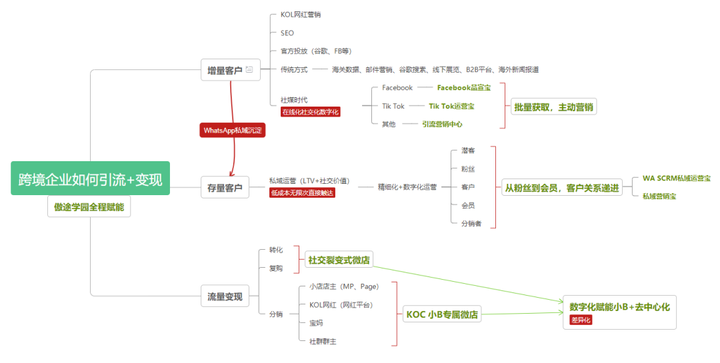
Before we begin, let’s talk about the company’s increment and stock. Generally speaking, there are two types of corporate customers and their sources of value: incremental and existing.Increment is public domain diversion, and stock is the result of owned-channel operations.
Increment refers to the company attracting new customers from the public domain and other domains, while stock is based on the conversion, repurchase, recommendation, etc. achieved by the company after operating existing owned channel customers, exploring the customer's lifetime value LTV and social value, in order to maximize the value of corporate customers and maximize the value of corporate operations.
At a time when the traffic dividends of public domain platforms have disappeared and social media has taken the initiative in traffic, the battle for traffic among enterprises is no longer as simple and straightforward as it used to be. At a time when operational involution, refined operations, and digital marketing have become mainstream, the battle between incremental and existing cross-border enterprises must also pay attention to focus and cater to the changes of the times.
2. Increment: Increasing traffic in the social media era has a focus
We can always find that every iteration of information technology means that some new things will come to the center of the stage of the times. The dividends of the times have never disappeared, but have been handed over from the so-called traditional hands to the hands of new things again and again. Where do people who do cross-border sales mainly get customers? From the initial offline exhibitions and customs data, to later email marketing, Google placement, B2B platforms, overseas news reporting SEO, etc., to the current social media era FB/TT, etc.
Social media dividends are coming to us like a tide. This is not an individual case, a regional characteristic, or an overseas or domestic exclusive, but the result of the joint action of all mobile Internet users.
I read WeChat when I get up early before going to bed, I go to Weibo to read entertainment gossip headlines, I scroll through Douyin in my free time, and I browse Little Red Book if I am interested in dressing up. This is true both at home and abroad. It’s just that WeChat was replaced by WhatsApp, Weibo was replaced by Facebook, Douyin was replaced by Tik Tok, and Xiaohongshu was replaced by ins. If you could describe the characteristics of this group of users in one sentence, it would be:
"Online socialization and digitalization"!
Yes, we have repeated these user characteristics in the social media era many times, and we would like to tell you this: If cross-border enterprises want to increase traffic, if you want people A, B, and D who have never met thousands of miles away to recognize you and buy your products, then achieve your first contact through the social media where they are stationed day and night.
For cross-border enterprises, social media is the focus of incremental traffic, so what is the focus of overseas social media? Facebook? TikTok? Or Twitter, Instagram, Pinterest, Youtube, etc.? Naturally, this is decided by the user.
For example, Facebook, the king of social media, firmly sits on the top spot in overseas traffic and is constantly expanding its boundaries. If it can't do something, it acquires someone, and constantly opens new features, etc., making users inseparable. Another example is Tik Tok, which has taken the world by storm, and has attracted many overseas users to become loyal fans of TT.
Therefore, we have batch marketing and traffic drainage tools developed for the Facebook ecosystem (Facebook Pinxuanbao), there are also short video intelligent marketing tools + cloud mobile phone technology based on the Tik Tok ecosystem (Tik Tok operation treasure). To attract incremental traffic from cross-border enterprises, we naturally start with the top priorities.
3. Inventory: owned-channel operations turn traffic into "retained" volume
There is no owned channel without public domain, and there is no public domain without owned channel. If the increment is public domain traffic, the stock is owned-channel operations that convert traffic into "retention". The growth problem from the perspective of cross-border enterprise stock naturally comes down to the quality of owned-channel operations of the entire enterprise. So, how do cross-border enterprises conduct owned-channel operations?
Let us take a sideways look at the growth and value of domestic owned channels. Thanks to the vigorous development of the WeChat ecosystem, we have seen the value of owned channels for new retail enterprises based on the integration of WeChat/WeCom online and offline. We have also seen the development of owned channel distribution, expansion of user lifetime value LTV and social value. From Made in China to Copyfrom China, we are proud to admit that China's mobile Internet technology is in a leading position, and we must be good at learning and applying it, using the mature experience of owned channels to empower overseas marketing growth.
SocialEpoch clarifies an idea from the cumbersome owned-channel operations, namelyThe progression of customer relationships from potential customers to fans to customers to members to distributors enables customers to deepen their understanding of the company and strengthen their emotional ties with the company, thereby realizing the realization of the value of owned channels and turning customers from traffic to "retention".
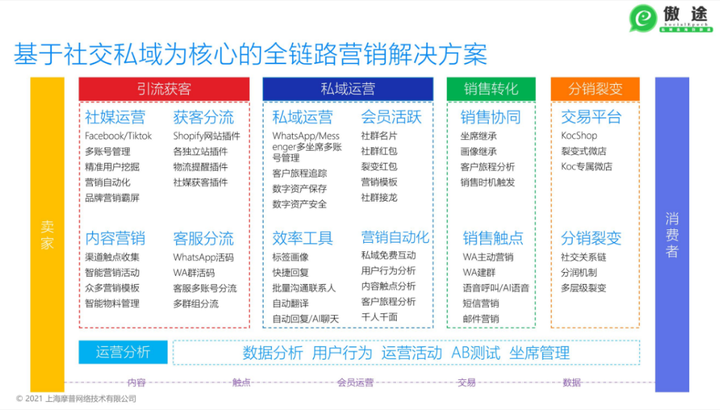
Whether it is offline contact, customers attracted by online social media such as FB/TT, or customers introduced, enterprise owned-channel operations are faced withCharacteristics of customers with massive numbers, thousands of people, and long links. In this process, companies will haveDraining customer acquisition, refined operations of owned channels, transformation from sales to distribution fissionWait for the key customer stage, and what SocialEpoch does is to establish in this intricate processA full-link marketing plan with WhatsAppowned-channel marketing as the core. Through refined digital operations, we can efficiently acquire customers in a variety of ways, attract customers with content, connect corporate sales and customers with SCRM tools, and promote transaction fission with profit-sharing distribution malls.
Of course, there will be a massive amount of content, touch points, distribution mechanisms, transactions, data, etc. in the entire process of overseas owned-channel operations. Different cross-border models/categories/scenarios will have different gameplay.
Four.Incremental to stock: social links
Social links have many advantages:
- one-to-one contact;
- Reachable in real time;
- Instant transaction;
- There are temperature close links;
- Enhance users’ sense of participation;
- Interaction methods are diverse and fragmented;
- You can use social circles to expand, etc.
Increment and stock are not two mutually exclusive lines. Through social links, enterprises can convert increment into stock and establish an owned audience pool, thereby monetizing traffic and realizing corporate profits.
5.Traffic monetization: the ultimate goal
On the road to monetizing cross-border enterprise traffic, SocialEpoch has always advocated differentiated monetization methods, through social fission and empowering overseas KOC small B, that is, S2B2C distribution and monetization.
- For customer conversion and repurchase, cross-border enterprises can use social fission micro-stores to sell goods directly;
- KOC small business owners who are willing to participate in distribution (such as small store owners, KOL internet celebrities, overseas mom groups, community leaders, etc.) can empower small business owners through decentralization + digital technology, establish exclusive micro stores for each distributor, and achieve revenue growth for the company by empowering small business owners to complete transactions.
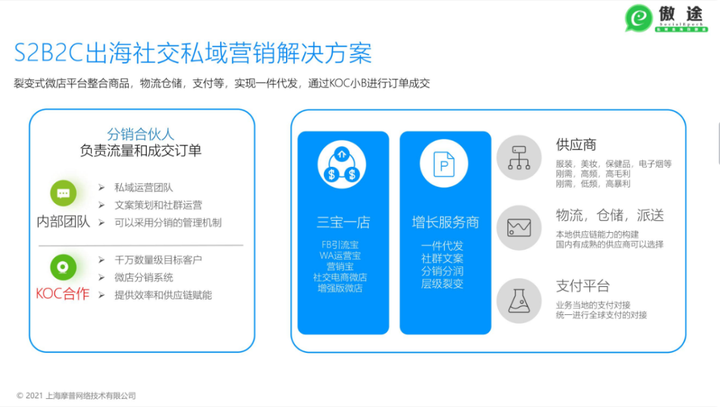
This will also become a huge opportunity for cross-border enterprises to gain growth through differentiated distribution in the future.
From incremental to existing, cross-border enterprises need refined digital owned-channel operations; from traffic to monetization, cross-border enterprises need differentiated and decentralized distribution fission.Owned channelglobal expansion is available at SocialEpoch for more insights into the growth of customer acquisition by cross-border enterprises. Welcome to discuss and discuss.