As the saying goes, cross-border sales merchants have three major difficulties: no inquiries, no conversions, and no repurchases. The saddest thing is that I spent all kinds of money to attract traffic, and the operation was as fierce as a tiger. The customer was contacted and the product was introduced, but in the end there was no conversion. Is it that the price is too expensive, the quality is not good, or there is a problem with the salesperson's ability?
No! If your inquiry is not converted, don’t rush to blame it on the salesperson!

Inquiry internal consumption 1: writing follow-up in vain, customer data cannot be reviewed in a timely manner
When communicating, do you always have endless follow-up records, but when communicating with customers, you are still at a loss. Customer follow-up is written in the CRM, but customer contact is in WhatsApp. As a result, it is difficult to correspond to customer needs and personal information one by one. What's more, searching the CRM system or self-built forms one by one is time-consuming and labor-intensive, and the efficiency of customer communication is also very low.
Inquiry internal friction 2: Internal collaboration is out of sync and customer experience is poor
Cross-border sales are typical B2B, or communicating with super large C customers. This type of customer communication will have a typical feature: long links and multiple roles. Many times multiple people with multiple roles serve one customer. The customer talked to the salesperson, and then wanted to talk to the manager. After the manager talked, he wanted to talk to the person in charge of the company. After the chat, the internal staff had not had time to synchronize with each other. The customer found that the information was asymmetric and the previous and previous statements were inconsistent. The natural experience was poor, and the inquiry conversion effect was not good.
Internal consumption of inquiries and internal consumption of resources is often caused not by the incompetence of the salesperson, the inability of the product, or the price being too expensive, but by the lack of timely information and lack of coordination. These inconspicuous problems, in a small way, affect the service efficiency of individual customers, and in a big way, they unknowingly affect the company's operating results.
How many inquiries are still lost due to unwarranted internal friction? It’s hard for us to estimate, but it’s time to stop this!
In the Social CRM (SCRM) system, this problem can be easily solved: because SCRM integrates customer management and customer service communication, communication sessions are on the left, and follow-up is written in the information column on the right, breaking the wall in information for you.
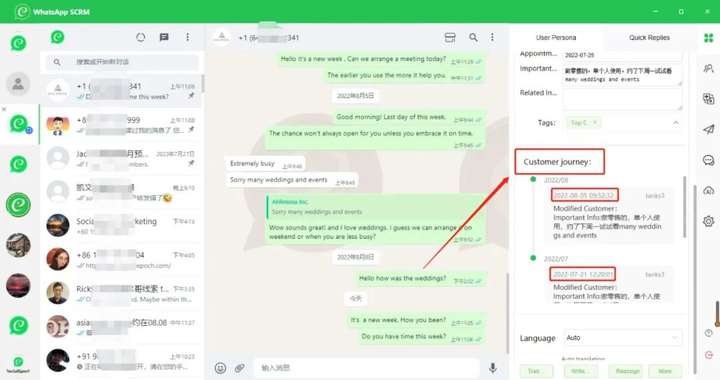
Before the SCRM era, customer follow-up records were relatively lagging and scattered. Many salespeople contact customers through various forms such as emails, phone calls, IM tools, etc., and then complete follow-up records within the CRM. Firstly, customer data is relatively lagging behind, and secondly, there is a gap in information.
In the era of WhatsApp SCRM, these problems no longer exist.
First, IM determines the premise for online instant communication; secondly, SCRM is based on native R&D design and realizes online customer data follow-up records on the premise of online instant communication.
By opening WhatsApp SCRM, salespeople can communicate with customers while writing follow-up notes. They can also write follow-up notes without leaving WhatsApp. These follow-up records include but are not limited to user basic information such as name, gender, occupation, email, address, notes, tag information, customer stage, customer source, etc. You can also freely edit customer follow-up records and add pictures. Chat communication on the left and follow-up records on the right are timely, efficient and true, improving the salesperson's follow-up efficiency.
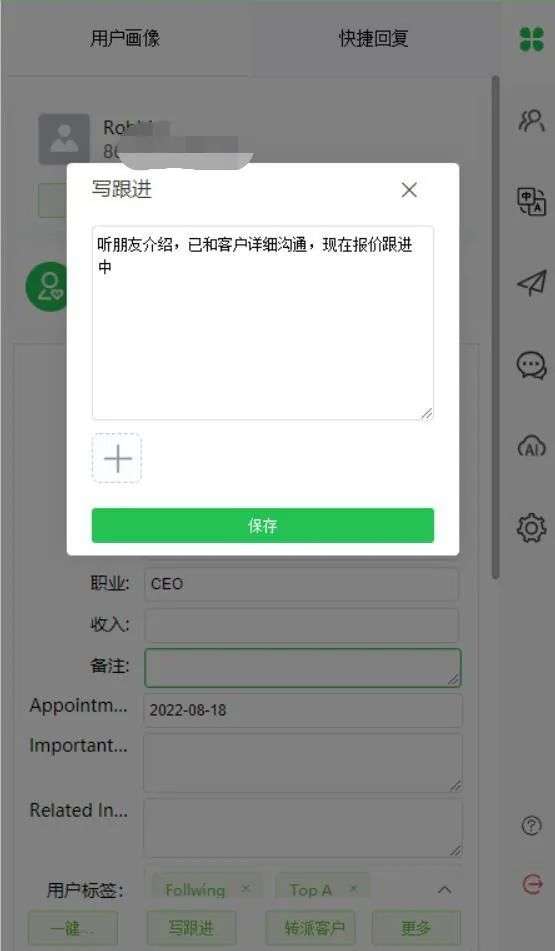
Writing needs to be efficient, and viewing needs to be even more efficient. Within WhatsApp SCRM, click on the conversation box to directly view the follow-up information of each customer. With a clear understanding of the customer's situation, you can naturally respond to customer needs calmly. Isn’t this what is called personalized precision marketing for thousands of people?
As mentioned earlier, B2B cross-border sales are characterized by long links and multiple roles. Facing these super users, in-depth 1V1 refined operations determine the customer experience, and also determine whether the customer makes a transaction, repurchases, or even makes a referral. In the SCRM system, customer data and labels are visually presented, which can effectively empower front-line service communication. Use information tools to reduce the workload of front-line salesmen, improve efficiency and customer experience, and reduce internal consumption of inquiries.
The one-to-one information barrier has been broken down. What if it is a many-to-one situation? Of course there is a solution: collaboration!
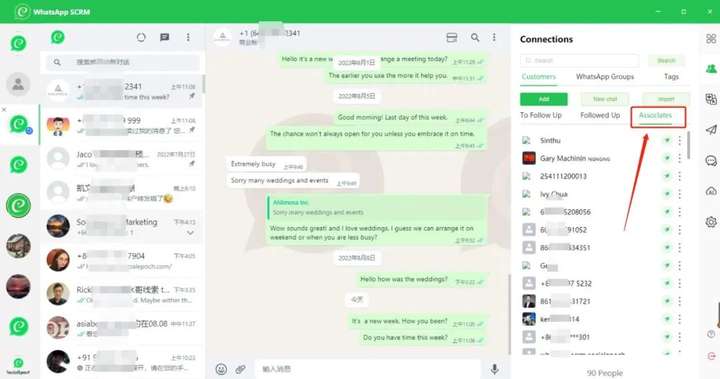
Open the WhatsApp SCRM customer conversation box, and the customer data column on the right has the function of adding collaborators. By adding collaborators, you can achieve:
1. The added collaborator can directly initiate a conversation with the customer on the client;
2. Customer data is updated, and all collaborators can be displayed simultaneously;
3. After any collaborator communicates with the customer, he only needs to write a follow-up record in time, and other collaborators can directly check the customer's latest information.
Through internal collaboration functions, internal information gaps are eliminated and customer dynamic information can be easily synchronized. A coordinated action can make internal communication more efficient, maintain a high degree of consistency and unity externally, and leave a good impression of professionalism and unity on customers.
WhatsApp SCRM, through the information bar function on the right side of the customer conversation box, helps staff record customer data in a timely and efficient manner, intuitively check and gain insight into customer situations, eliminate information lag, siled islands, out-of-synchronization and other problems, improve the efficiency of internal information communication and flow, and use online digital information collaboration to eliminate unwarranted internal friction.
In the customer communication scenario of one-on-one intensive chatting with B2B customers, front-line personnel, internal collaboration, and information exchange are empowered.
Preview for the next issue: In business scenarios such as cross-border sales where one-to-one intensive chats are required, in addition to accurately grasping user information portraits, the professionalism, timeliness, and accuracy of the communication content are also the key to influencing the transaction and repurchase. In the next issue, we will talk about how to improve customer experience and reduce unnecessary internal friction from these three perspectives of customer communication content.